Charts are reproduced from the original Norwegian report.
The property market
A long-awaited upturn in the transaction market
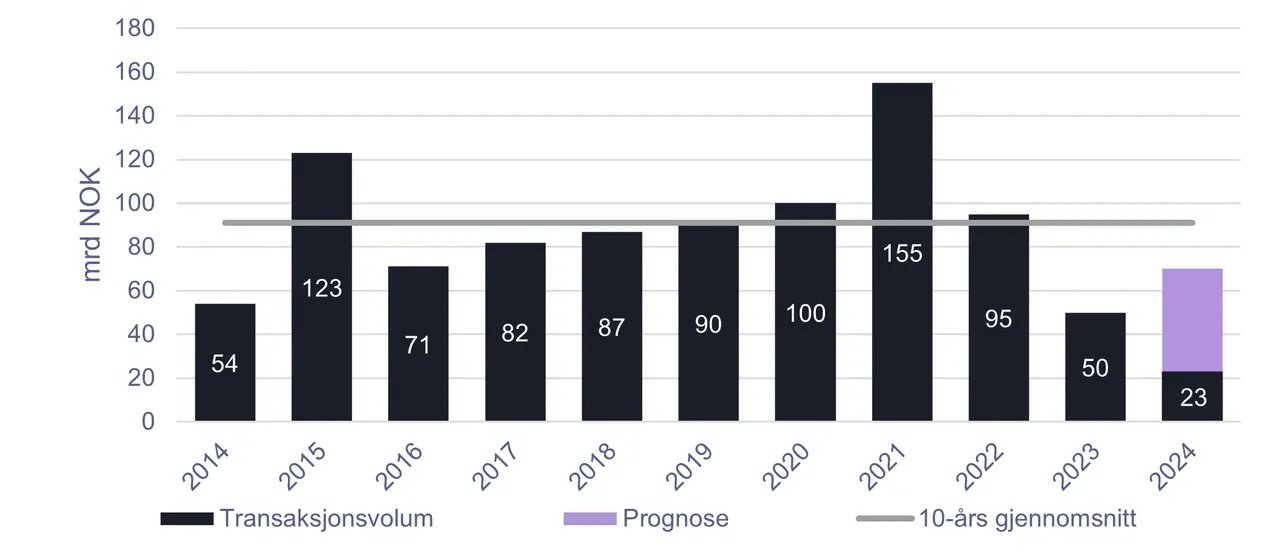
After a significant decline in transaction activity in 2023, with the lowest volume in over ten years, volume in the first quarter of this year has increased markedly. As of Q1 2024, volume had reached NOK 23 bn, spread across 34 transactions. This represents an increase of 58 per cent compared with the same point last year. It is also the second-highest transaction volume ever recorded in a first quarter, behind only the record year of 2021. This is despite the number of transactions having fallen by more than 60 per cent compared with last year.
Average transaction size has been very high so far this year, at over NOK 670 m. This is almost twice the average from 2019 to 2023. During the first quarter there have been several large, benchmark-setting transactions, involving both larger portfolios and single assets. Some of the largest and most notable transactions include:
| Property | Buyer | Seller | Value (NOK m) |
|---|---|---|---|
| Marine trading portefølje | NREP | Marine Trading | 1,300 |
| Entra Trondheim portefølje | E C Dahls Eiendom | Entra | 6,450 |
| Tjuvholmen Allé 11, Oslo | KLP | Aspelin Ramm | 844 |
| Stortorvet 7, Oslo | KLP | Schage | 2,500 |
| Equinor-bygget, Fornebu | NPRO | Artic-syndikat | 2,840 |
Source: Realnor
Several of the large transactions relate to the fact that many property players need to reduce their balance sheets – which is, and has been, expected following the interest rate and value developments of recent years. Some transactions are carried out to reduce debt and/or free up capital for new projects, while others are forced by circumstances.
For example, Norwegian Property acquired the Equinor building at Fornebu from an Arctic syndicate following a breach of loan covenants. The transaction price was more than NOK 1.0 bn lower than the purchase price in 2016. The transaction clearly shows how the value of certain commercial buildings has developed, even though it was a special situation and property. Buyers are no longer willing to accept "yesterday's" prices, and sellers must adjust to the new reality for transactions to go through. In other words, it takes a good deal for a buyer to be willing to commit.
Several transactions have also been completed that have given us good indications of various yield levels. KLP's acquisition of Tjuvholmen Allé 11 was at a yield of around 4.6 per cent, which largely confirms the market consensus of a prime yield of around 4.7 per cent. KLP also bought the newly refurbished Stortorvet 7 from Schage, at a yield just above 5 per cent. It is important to note that KLP is not dependent on external capital and is therefore in a different position from many other property companies.
Several large players have also indicated and stated that they wish to sell property in 2024. Consequently, more large transactions are expected in the period ahead. However, it is estimated that volume will not necessarily remain at the same level through the rest of 2024 as we have seen in the first quarter. Increased uncertainty in the interest rate market and expectations of delayed rate cuts contribute to these expectations.
The office market – the CBD stands out
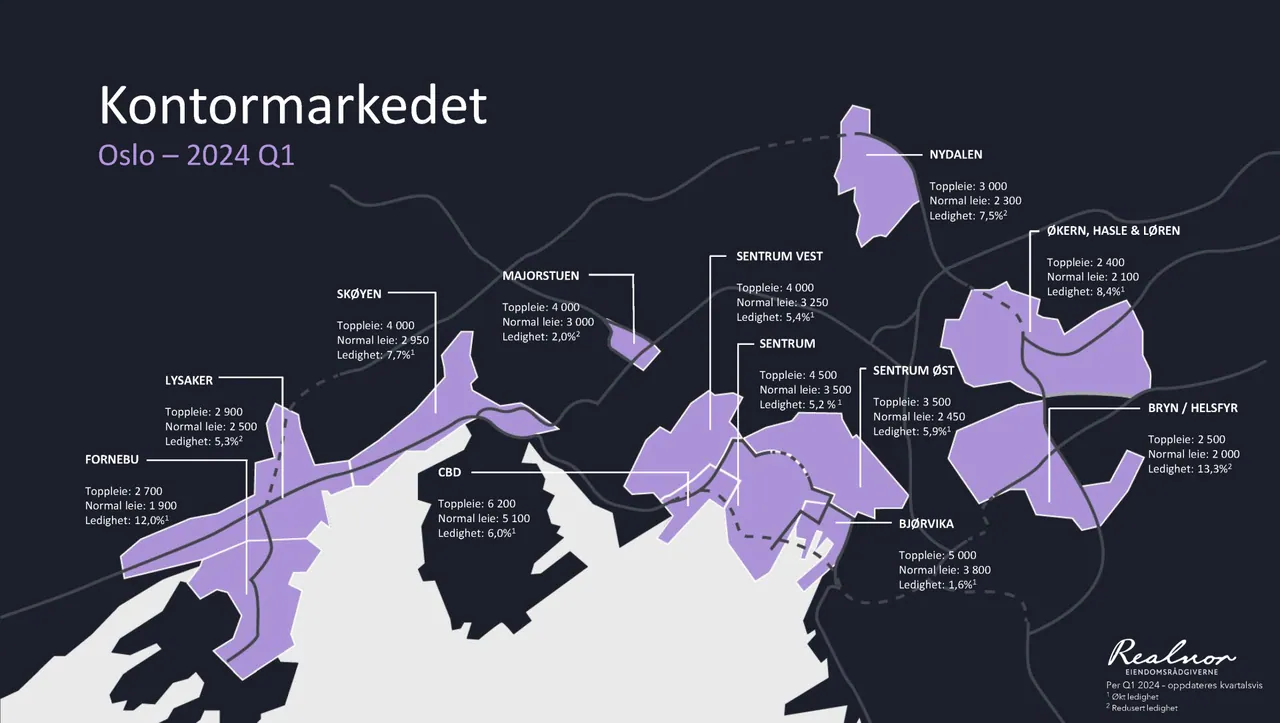
The Oslo office market remains relatively stable, despite a gradual increase in vacancy. As of March 2024, the six-month moving average vacancy rate had risen to 6.7 per cent from 6.4 per cent at the start of the year. Although vacancy has risen steadily since mid-2023, it remains at a relatively moderate level. Strong employment figures support this trend, and there are few indications of a slowdown in companies' search for premises.
At the same time, there are relatively large differences in the leasing market. In areas such as Helsfyr and Fornebu, vacancy is well above 10 per cent, and it is to a greater extent a tenant's market. In contrast, vacancy is low in the CBD, Bjørvika and the city core, and supply is limited for many companies. Consequently, rents are coming under pressure, and this also leads to a high level of renegotiations. This applies in particular to large occupiers that require large floor areas and want optimal locations and new-build standard. In this segment, choice is even more restricted.
Rents and the number of square metres of office space signed are also holding at relatively stable levels, according to Arealstatistikk. The prime segment in the CBD continues its strong performance, and limited supply around Vika and Aker Brygge is pushing rents ever higher.
The logistics market – the preferred segment among foreign investors
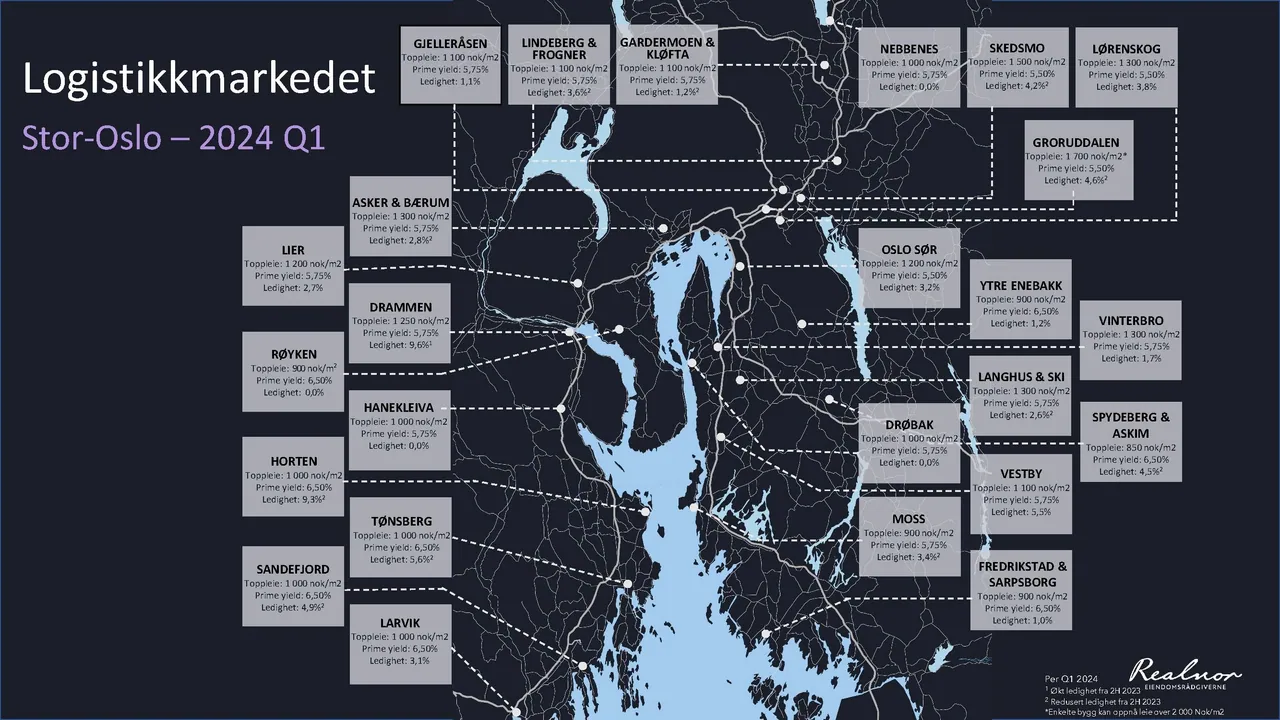
In the logistics market, demand remains strong and vacancy remains low in Greater Oslo. Investor appetite has picked up somewhat from 2023, and several significant logistics sales have been completed this year – albeit at markedly lower prices than at the peak in 2021. So far, volume is almost equivalent to that for 2023 as a whole. As in the wider transaction market, few but large transactions have been completed, and we have had three transactions above NOK 1.0 bn in Q1. NREP has been active, acquiring the whole of Marine Trading with its nine logistics properties and land bank in Moss. In addition, it has acquired 49 per cent of Wilog's warehouse portfolio – a portfolio of 18 warehouse and mixed-use buildings (130,000 sq m) centrally located in the Oslo area. Most recently, a foreign player also acquired Sjømatsenteret at Gardermoen for over NOK 1.3 bn.
All three large acquisitions were made by foreign companies, while all were sold by Norwegian companies. Foreign investors have a particularly strong appetite for the logistics segment. At the same time, the Norwegian syndicates, which have historically been significant net buyers of logistics properties in recent years, have been far less active during this period.
The retail market
Shopping centres continue to deliver
2023 turned out to be a surprisingly good year for the shopping centre industry as a whole. According to Kvarud Analyse, sales at all the centres in their analysis rose by an average of 4.3 per cent. The ten largest centres also reported a 4.5 per cent increase in sales. This result was far better than many had expected, despite real sales growth, adjusted for inflation, being negative.
So far in 2024, shopping centres have also seen a significant increase in sales, with impressive growth of as much as 9.1 per cent in February. Much of this growth can be attributed to an extra trading day in the month, as well as a price increase of 4.5 per cent. The most marked growth has been observed in district and local centres, and across sectors it is still services that show the strongest growth. In March, sales fell back by 0.3 per cent, but this is due to three fewer trading days than last year. Adjusted for the number of trading days, sales in March rose by 12.0 per cent, making it a very good month for shopping centres.
Retail trade – online retail picks up speed
As regards retail trade, figures from Statistics Norway (SSB) showed that sales volume fell marginally in January and rose marginally in February. Over the last three months, however, retail trade has fallen by 0.6 per cent compared with the previous three-month period. Consumption is gradually declining, and consumers are buying fewer goods, but in return they are paying more per item on average. A decline is particularly evident in durable goods, with categories such as car purchases, furniture and interiors especially affected. Consumers are also becoming increasingly price-conscious, and discount chains such as Kiwi, Coop Extra and Rema 1000 continue to win market share from their competitors.
There are clear differences between sectors within retail, but many players are struggling with profitability. Nevertheless, the number of bankruptcies in retail remains at "normal" levels. Costs are rising, and many businesses have to pass these increased costs on to consumers. This poses a particular challenge for players already operating in competitive sectors with squeezed margins. Such players are especially vulnerable and depend on passing the increased costs on to consumers.
Online retail continues to grow in both volume and value, and in January this year showed growth of almost 10 per cent compared with January last year.
Macroeconomy
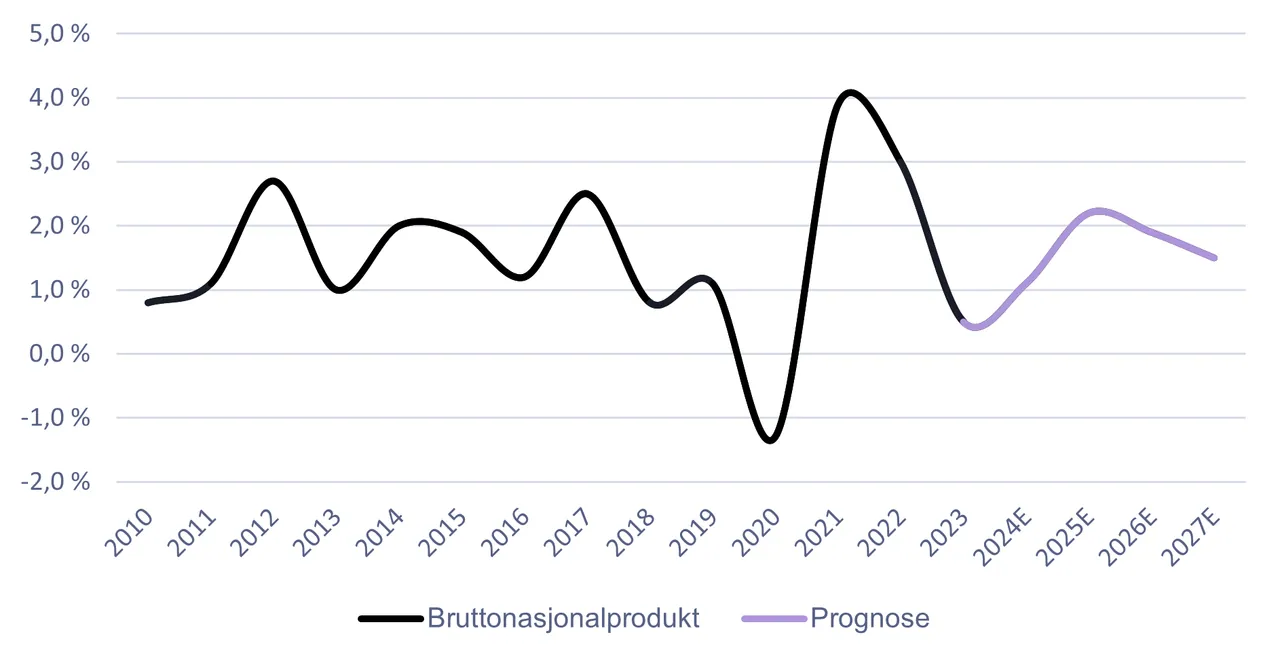
- Weak development in the Norwegian economy through 2023 – construction pulled growth down the most
- The mainland economy contracted by 0.2 per cent in February after rising in January
- Activity will gradually pick up, and a soft landing is expected for the Norwegian economy
- Increased purchasing power will take Norway out of the downturn in 2025, according to Statistics Norway
- Mainland GDP is projected to grow by 1.0 per cent in 2024 and by between 2 and 3 per cent in 2026 and 2027
The labour market
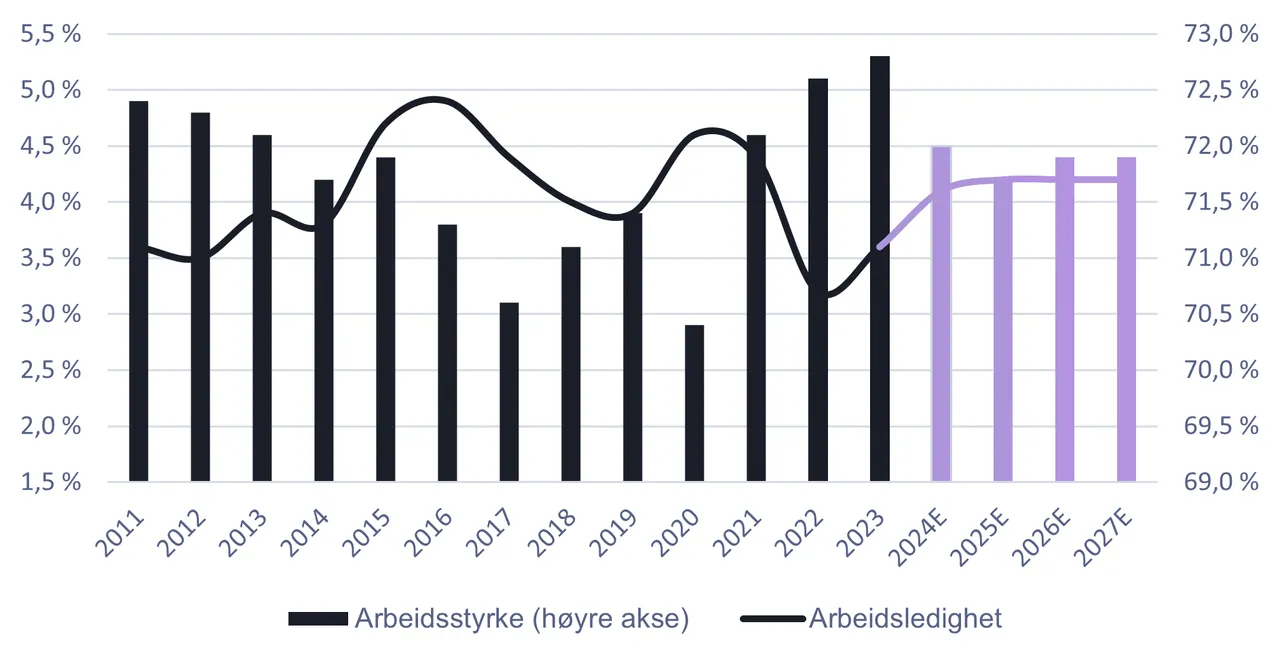
- Unemployment of 3.8 per cent in February (LFS) – employment remains stable
- High wage growth will result in real wage growth in 2024
- Statistics Norway expects unemployment to rise going forward, driven largely by the many Ukrainian immigrants
- The fall in residential investment also means that more people will become unemployed in the construction industry
- Unemployment is expected to rise to 4.1 per cent this year and then increase further to around 4.2 per cent in 2025
CPI
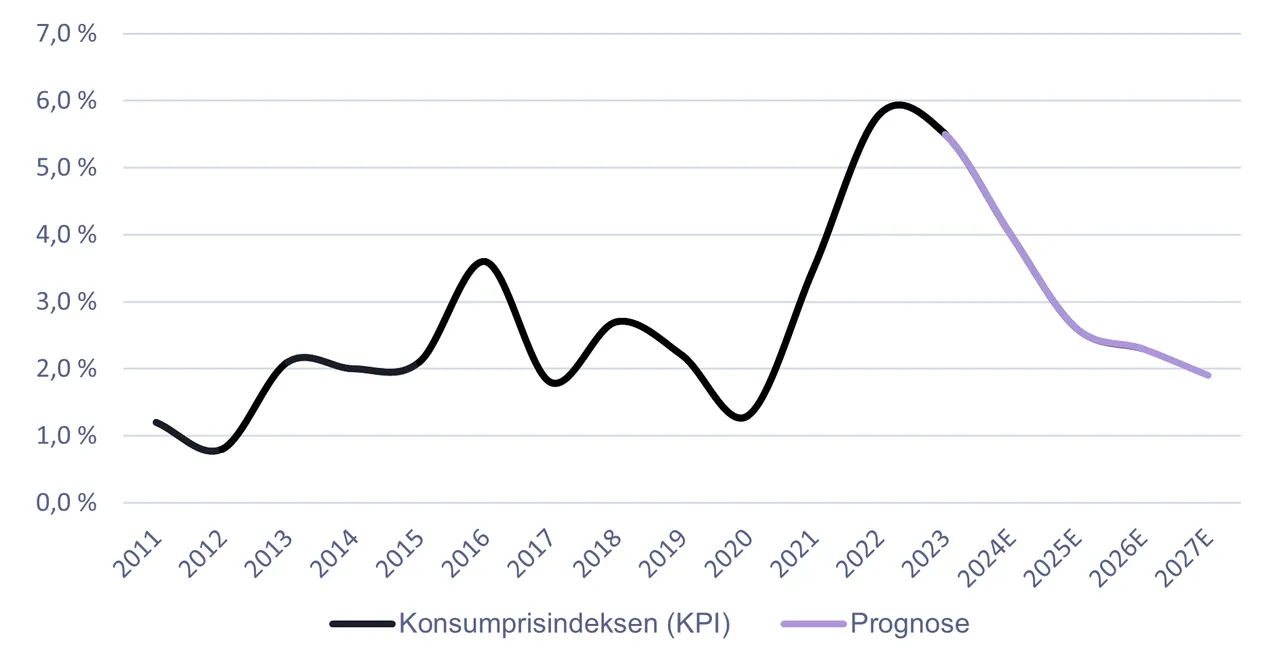
- Twelve-month growth in inflation and core inflation of 3.9% and 4.5% respectively in March 2024
- Food prices pulled inflation down in February after the grocery chains moved away from a Norway-specific negotiation system
- Inflation is easing and has fallen for three consecutive months
- Annual inflation is projected at 4.0 per cent in 2024, with twelve-month growth falling towards 3 per cent by the end of 2024, according to Statistics Norway
- The inflation target will not be reached until 2027, according to Norges Bank
The interest rate market
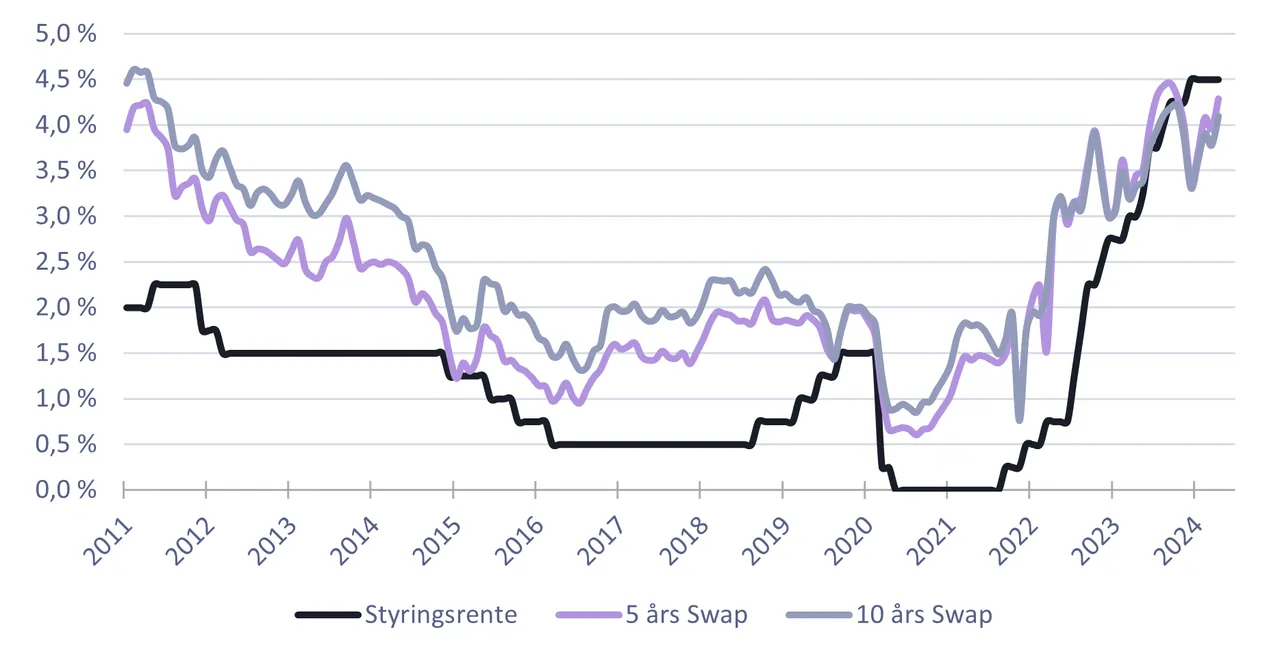
- The policy rate was held unchanged at 4.50 per cent following Norges Bank's monetary policy meeting in March 2024
- Norges Bank's rate path indicates the first rate cut in September 2024 and a further two rate cuts in 2025
- A persistently weak krone and high inflation are pushing up the rate path
- Swap rates have been in the range of 3.6 to 4.2 per cent, but have recently risen on expectations of delayed rate cuts in the US