Charts are reproduced from the original Norwegian report.
The property market
The transaction market
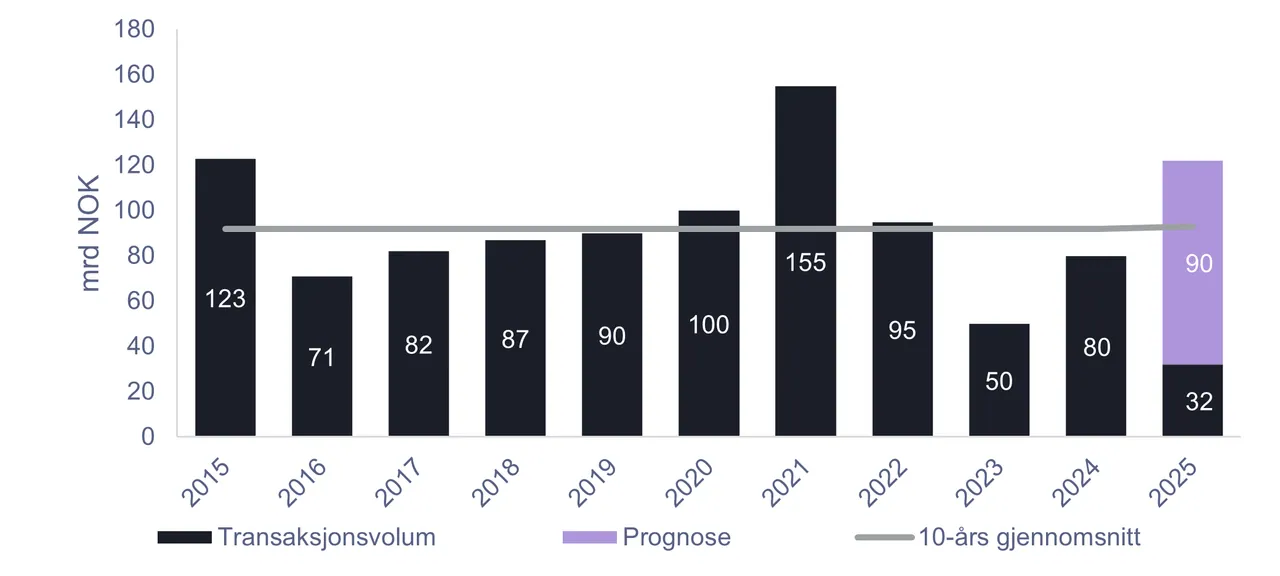
In 2024 we ended up with a total transaction volume for the year of around NOK 80 bn. This was a marked improvement on the previous year, which is regarded as one of the worst years for the transaction market. At the end of June 2025 we have registered a transaction volume of just over NOK 32 bn. This is considerably lower than last year, when we registered a volume of NOK 43 bn at the same point. That volume was, however, boosted by, among other things, Entra's sale of its property portfolio in Trondheim to EC Dahls Eiendom for NOK 6.45 bn.
So far, 2025 has been characterised by persistent macroeconomic and geopolitical turbulence, which affects the risk picture in the Norwegian commercial property transaction market. Internationally, the deteriorating security situation in the Middle East and growing tensions between the USA and China are contributing to uncertainty in global financial markets. At the same time, Norges Bank has now lowered the policy rate by 0.25 percentage points to 4.25 per cent – a signal of the start of a period of cautious monetary easing. This gives greater confidence in a more predictable and lower interest rate path going forward.
A gradual improvement in market sentiment is now being reported. Nevertheless, many are still holding back, and transaction processes remain time-consuming. High long-term interest rates and continued limited access to capital particularly affect segments with high loan-to-value ratios and keep appetite for acquisitions subdued.
On the other hand, we see that well-capitalised players and investors with low or no leverage continue to dominate the market. These players operate more opportunistically and are better able to take advantage of price corrections and reduced competition for attractive assets. With the prospect of further rate cuts and greater clarity in the macro picture, increased transaction activity is expected towards the second half of 2025.
Among the larger transactions so far in 2025, we can highlight Capman's acquisition of 28 hotel properties, 8 of which were Norwegian, through its purchase of Midstar Fastigheter. This was the largest hotel transaction ever in the Nordics. Furthermore, KLP has acquired Selvaag Utleiebolig's property portfolio for NOK 3.3 bn, in addition to a rental portfolio at Ulven in February for NOK 1.1 bn, thereby becoming one of Norway's largest players in rental housing. With these large transactions dominating the first quarter, we see that residential is currently leading the way in transaction volume. We also see that office, as usual, still accounts for a significant share of total volume. For 2025 we are forecasting a total transaction volume of NOK 90 bn, which is roughly in line with the 10-year average.
The office market
Future developments depend largely on three factors: the strength of the economic upturn, the degree to which tenants use space more efficiently, and how the geopolitical risk picture develops. If international political turbulence persists, including the tensions in the Middle East and uncertainty about US foreign policy after the election, this could further reinforce companies' caution. At best, the market could stabilise towards the end of the year, driven by increased demand, the need for upgrading and low new construction after 2026. At worst, vacancy could rise further and rents remain under pressure into 2026.
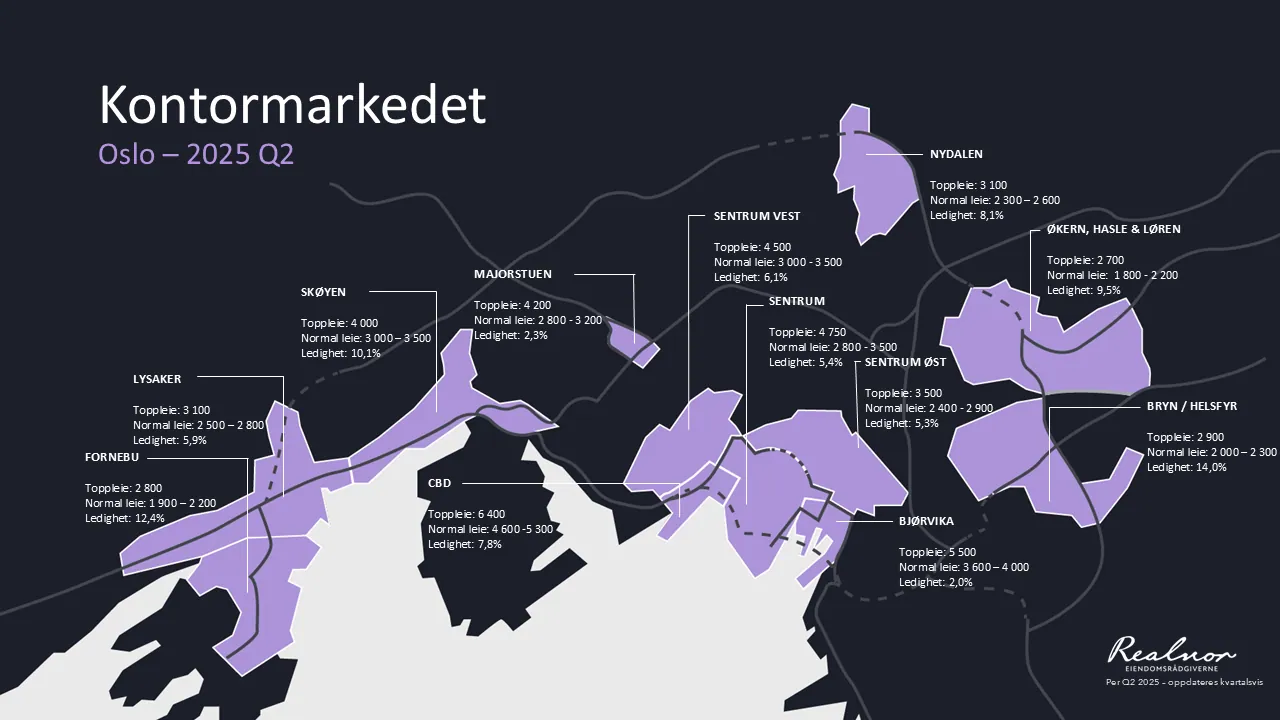
Office vacancy in Oslo is now 7.6 per cent for Oslo as a whole. It is lowest in Bjørvika at around 2 per cent and highest at Bryn/Helsfyr, where vacancy is around 14.7 per cent. Office vacancy in Oslo has risen steadily since the end of 2024, which is in line with expectations owing to the completion of several new-build and refurbishment projects. However, there are also many vacant, smaller premises that contribute to pushing overall vacancy upwards.
According to figures from Arealstatistikk, 193,910 square metres were let in the first quarter of 2025, spread across 183 contracts. This is a marginal decline in square metres from the previous quarter, but the number of contracts signed is down from 242. Rents have developed relatively flatly, with the two-quarter moving average rent for Oslo up 2.0%, while the geographically weighted rent is up 1.0% in the first quarter. There is broad agreement that 2025 will be a year without real rental growth. Forecasts have been revised down, and a growing supply of vacant premises, particularly in the segment below 500 sq m, is putting pressure on landlords. At the same time, rising construction costs and high capital requirements could lift rent levels in the longer term, particularly in new buildings and fit-outs, provided that growth in the economy materialises.
The logistics market
So far this year, warehouse and logistics, industrial and mixed-use properties account for approx. 19% of total transaction volume, equivalent to NOK 5.6 bn. At the same time last year, the segment accounted for a considerably larger share of total transaction volume at approx. 27 per cent, equivalent to NOK 11.5 bn.
Over the past few years, the warehouse and logistics market in Norway has been among the property sectors with the strongest structural demand, but the market is now showing signs of entering a more balanced phase. After several years of strong rental growth, prices levelled off in the first half of 2025. This is largely due to weaker macroeconomic prospects, low private consumption and more normalised inventories after the pandemic years and the energy crisis.
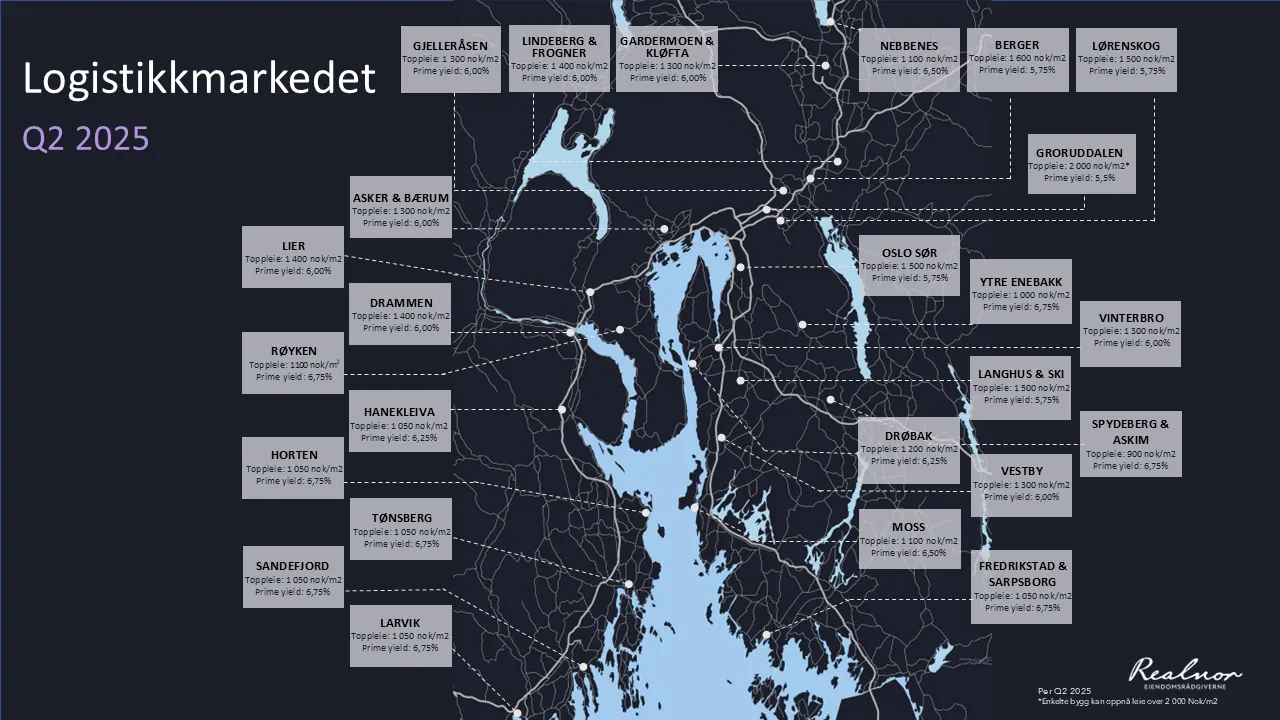
Rents for the most attractive logistics space in the Oslo region and along the main transport arteries (the E6/E18 corridor) remain high, but have essentially stabilised. On average, rents for new warehouse and logistics buildings are around NOK 1,800–2,100/sq m, depending on location, standard and size. It is particularly the segment below NOK 1,500/sq m that is showing some price growth, as demand for more affordable space remains high among medium-sized tenants.
So far this year, warehouse and logistics, industrial and mixed-use properties account for approx. 19% of total transaction volume, equivalent to NOK 5.6 bn. At the same time last year, the segment accounted for a considerably larger share of total transaction volume at approx. 27 per cent, equivalent to NOK 11.5 bn. This creates a capacity constraint on the supply side, and the imbalance between supply and demand is expected to become more pronounced as demand picks up in line with expected economic growth towards 2026 and 2027.
At the same time, there are clear signs that the best properties – in terms of location, ESG qualities and space efficiency – are holding up well and often achieve higher rent levels. Logistics tenants are becoming increasingly quality-conscious, and locations close to the main markets (Oslo, Drammen, Gardermoen) with good infrastructure capacity are prioritised.
The retail market
Shopping centres
According to figures from the Norwegian shopping centre index, shopping centre turnover rose by 3.9 per cent in May. Turnover so far this year has risen by 3.3 per cent, while prices rose by 2.8 per cent over the same period. The increase in May is explained by there being one more trading day in May this year than last year. Adjusted for this, there was a real decline in turnover of 0.9 per cent in May compared with last year.
The shopping centre segment of the Norwegian property market continues to show low transaction activity, and there are no significant changes compared with the same point last year. As of the end of June 2025, shopping centre property worth around NOK 500 million has changed hands, the same volume as at the same point in 2024. Activity is largely driven by a single transaction: the sale of Sjøsiden Senter and Sortland Storsenter in February, which together changed hands for just under NOK 500 million.
Retail trade
Throughout 2024, households remained cautious about increasing consumption, despite improved purchasing power resulting from real wage growth. In the first half of 2025 this trend has largely continued: rising housing costs, high interest rates and general economic uncertainty have contributed to a subdued willingness to consume. On the positive side, several indicators now point to a gradual easing of households' financial situation. Real wage growth continues, and with rate cuts expected towards the autumn of 2025, there is a basis for increased consumption later in the year.
Retail property accounted for around 5 per cent of the total transaction market in 2024, with a total volume for the year of NOK 3.8 bn. As of June 2025, retail property accounts for approx. 7 per cent of volume, equivalent to NOK 2 bn.
Taking the retail and shopping centre categories together, however, they accounted for around 10 per cent of total volume. This has declined towards the end of the second quarter of the year, with shopping centres and retail together accounting for just under 8.6 per cent of transaction volume.
According to Statistics Norway's retail trade index, the twelve-month change in retail trade excluding motor vehicles was 4.2 per cent in April 2025. The three-month change was 1.5 per cent.
Macroeconomics
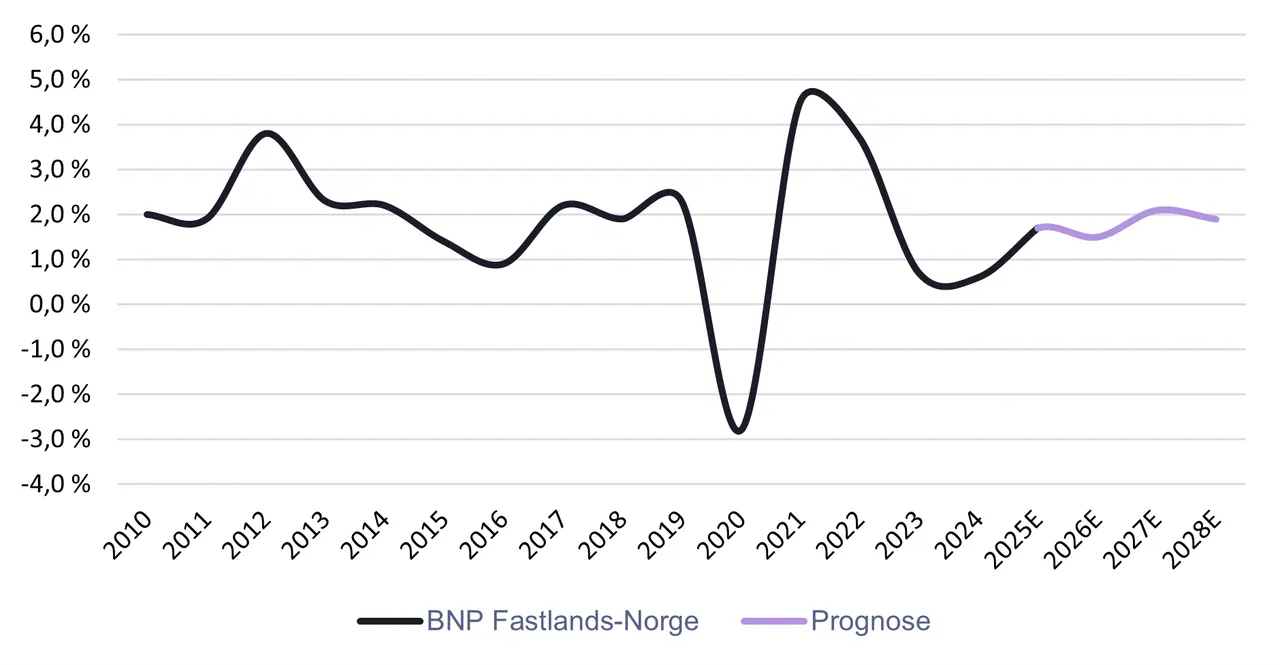
- GDP growth for Mainland Norway is expected to rise from 0.6 per cent in 2024 to 1.7 per cent in 2025 and then remain above 1.5 per cent in the 2026–2028 period. Activity is receiving a particular boost from public demand and higher consumption, while petroleum investment will pull growth down somewhat in the years ahead.
- Over the last two years, growth in the Norwegian economy has been weak, partly as a result of high inflation and interest rate rises. During 2025, however, growth has picked up, and real wage growth, rate cuts and expansionary fiscal policy are contributing to increased domestic demand and higher activity in the economy.
- Trade policy tensions and increased geopolitical uncertainty are likely to dampen global value creation. Nevertheless, the world economy is still expected to grow, albeit at a slower pace than before. For Norway's trading partners, growth is expected to slow to around 1.4 per cent this year, before gradually rising towards 2 per cent by 2028.
- Despite fragmentation in global trade, higher tariffs and geopolitical challenges, the Norwegian economy is expected to be lifted by increased real income, lower interest rates and expansionary public spending. Household consumption is expected to increase significantly in the coming years, driven by increased purchasing power and a lower savings rate.
The labour market
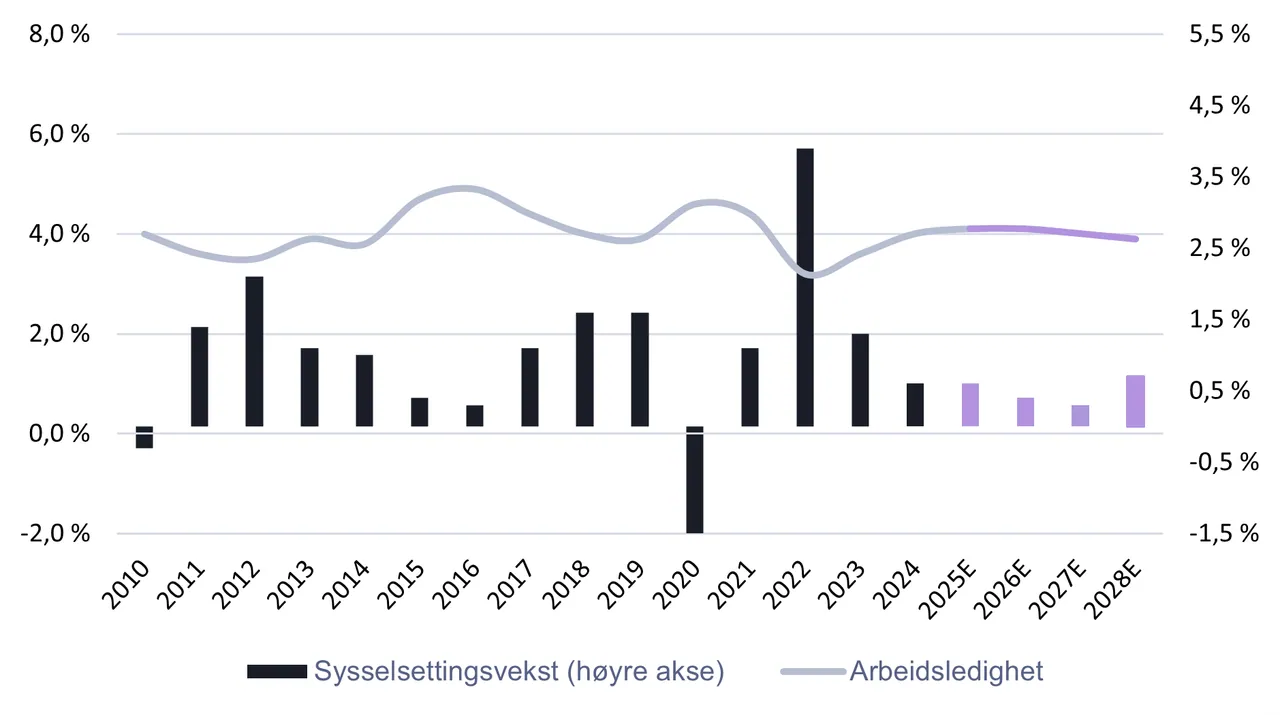
- Unemployment is also rising in NAV's statistics on registered unemployment, but there are signs that the situation may be stabilising. Employment rose in the first quarter of 2025, including in building and construction.
- Average accrued annual earnings rose by 5.6 per cent from 2023 to 2024. This gave real wage growth of 2.4 per cent – the highest since 2012.
- Annual wage growth is expected to decline gradually, from 4.4 per cent in 2025 to around 3.5 per cent in 2028. Despite this, positive real wage growth is still expected, driven by high nominal wage growth and moderate inflation.
- Unemployment, as measured by the LFS, has risen from 3.2 per cent in 2022 to just over 4 per cent in the first half of 2025. The latest trend figure from April shows unemployment of 4.3 per cent.
CPI
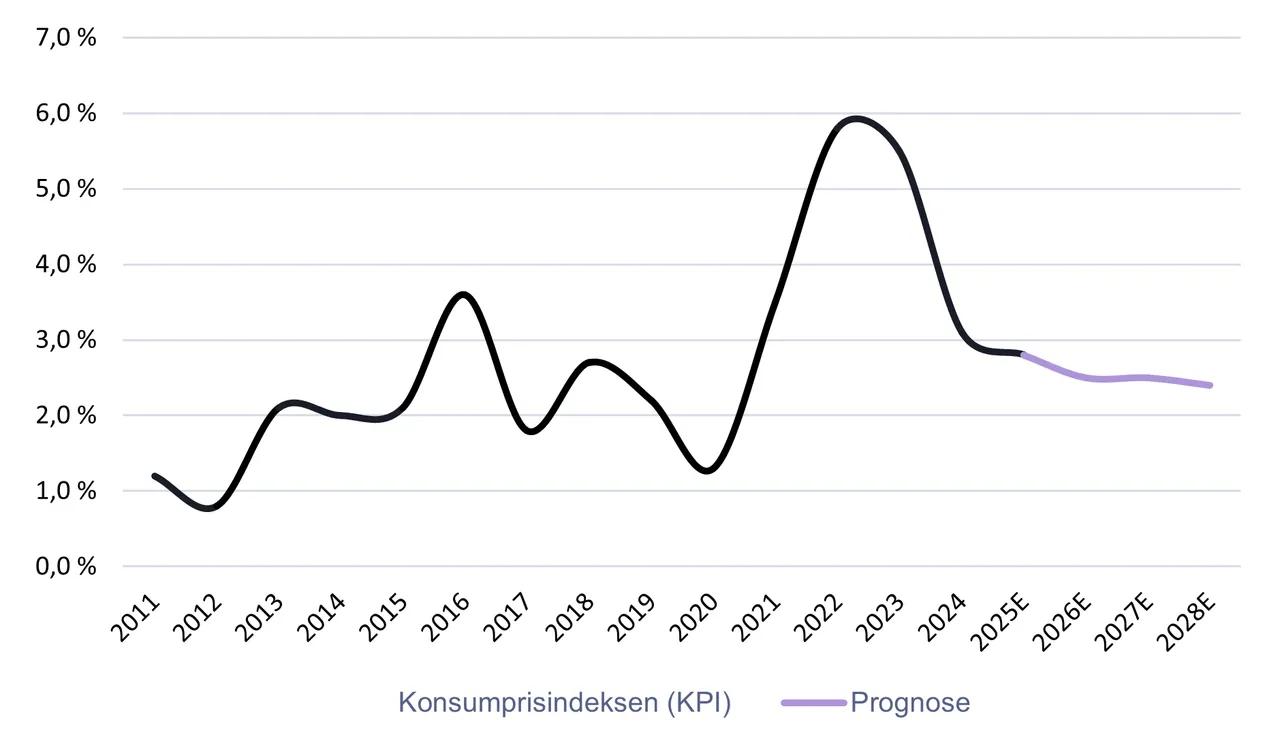
- Inflation is expected to remain above the 2 per cent inflation target over the next few years, partly as a result of continued high nominal wage growth, a weak krone and persistent international price pressures.
- Inflation as measured by the CPI was historically high in 2022 and 2023, but slowed considerably in 2024. Annual CPI growth ended at 3.1 per cent in 2024, down from 5.5 per cent in 2023.
- The CPI adjusted for tax changes and excluding energy products (CPI-ATE) rose by 3.7 per cent in 2024, down from 6.2 per cent the year before. These levels still represent the highest inflationary pressure since the 1980s.
- Although inflation has slowed, developments at the start of 2025 came as a surprise. In May, twelve-month CPI growth was 3.0 per cent, and Statistics Norway estimates that annual growth for 2025 will end at 2.8 per cent.
The interest rate market
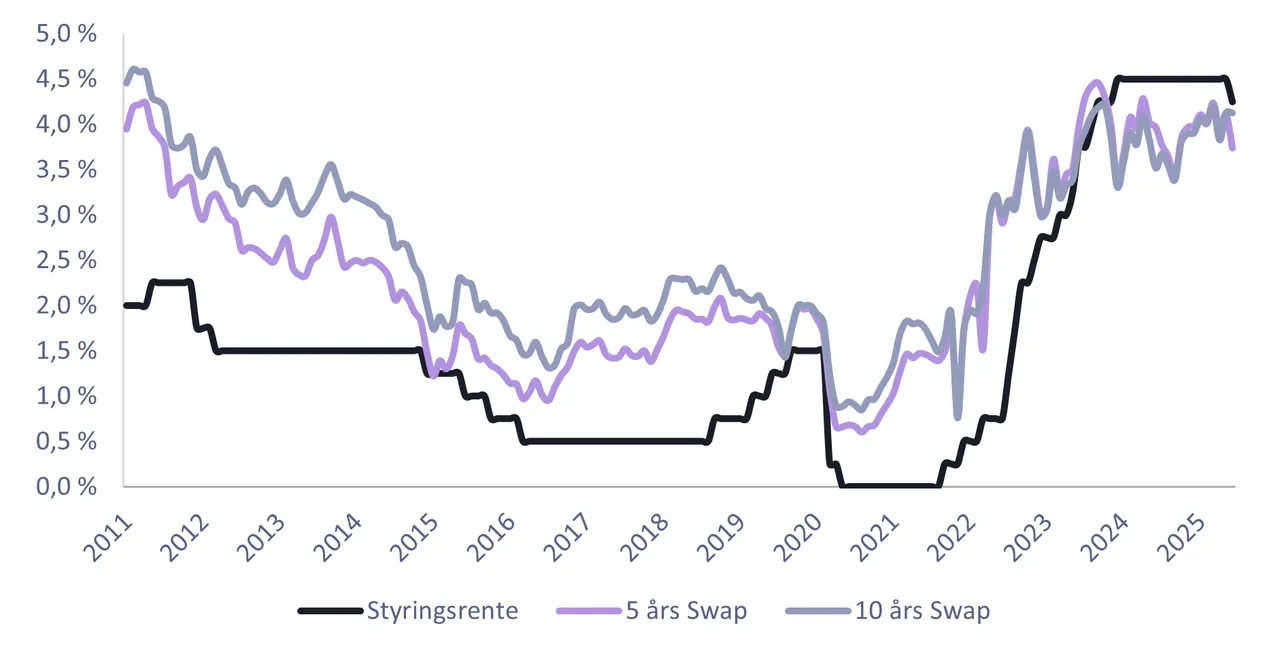
- The market is now pricing in fewer rate cuts, and in 2025 the 5-year swap rate has largely stabilised at a level of around 4 per cent, although swap rates have fallen somewhat in the wake of Norges Bank's rate cut.
- The policy rate had been 4.5 per cent since December 2023 – the highest level since the 2008 financial crisis – but on 19 June it was lowered by 0.25 percentage points to 4.25 per cent. Norges Bank signals that if the economy develops broadly as it is now, the policy rate will be lowered further during 2025 to just under 4 per cent.
- International uncertainty and increased geopolitical tensions have historically weakened the Norwegian krone, but high inflation and lower interest rate expectations abroad have helped strengthen the krone somewhat recently. Following the rate cut announcement, the krone weakened somewhat again. The import-weighted krone exchange rate has strengthened by 2.5 per cent since the previous economic report.