Charts are reproduced from the original Norwegian report.
Realnor has a long tradition of analysing the warehousing and logistics market in Greater Oslo and has published an annual market report on the subject since 2015. Our focus has mainly been on the logistics areas within the Gardermoen–Larvik–Moss triangle, which consist of larger logistics buildings. We have treated Groruddalen as a single area. More recently, Groruddalen has emerged as a highly preferred location, and much has been written about galloping rents and a bonanza market. Market rents are reported to have risen from NOK 1,400 per sq m to over NOK 2,000 per sq m in just a few years, and demand is said to be sky-high. But does this apply to all buildings and properties throughout Groruddalen? In this article we examine this by dividing Groruddalen into 6 different areas. For each area we describe its qualities, challenges and characteristics, concluding with an overall summary including rents and discussion. We hope you find it interesting reading, but first we will provide a market update on the warehousing and logistics market in Greater Oslo.
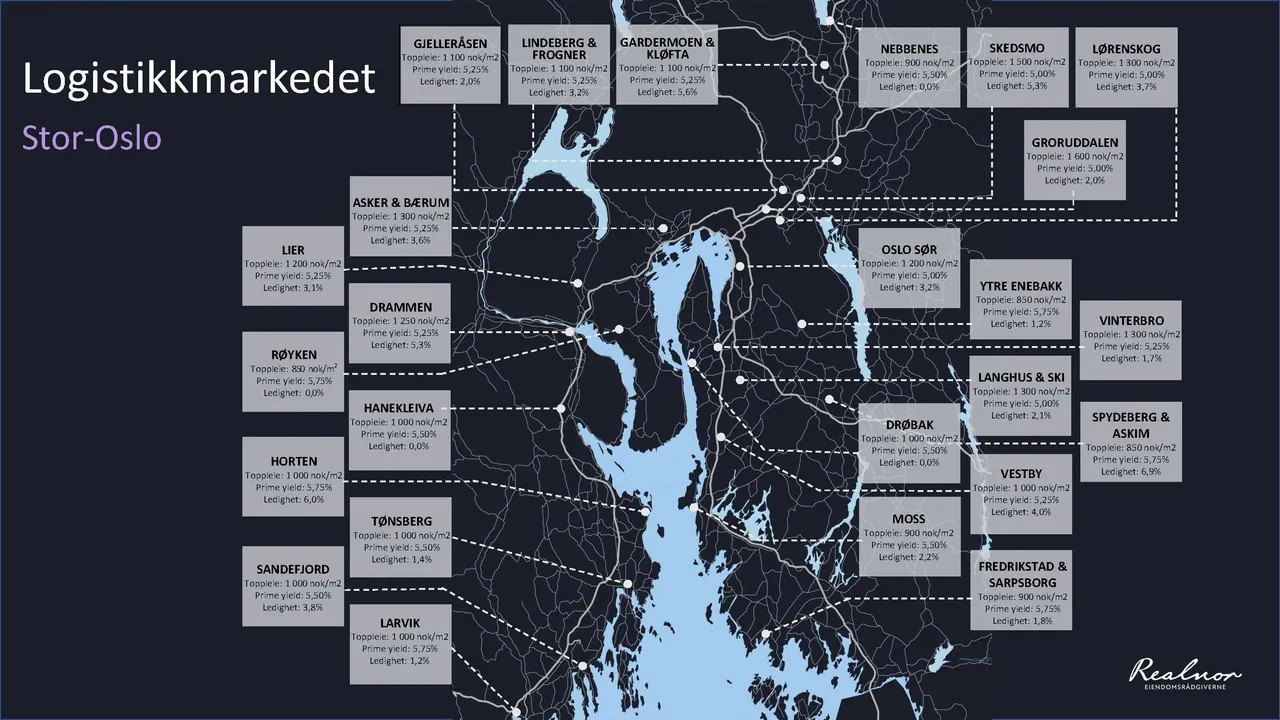
The property market has enjoyed strong tailwinds for a good while, and the warehousing and logistics market in Greater Oslo has in many ways led the way. Developments in e-commerce and a greater focus on efficiency, flexibility, sustainability and energy have resulted in new, modern and large logistics buildings lined up like pearls on a string along the main arterial roads out of Oslo. Activity is still relatively good, but macroeconomic developments over the past year have also affected the logistics market. Investors have become more selective, and very few transactions are being completed. Nevertheless, the letting market is strong and vacancy remains low in the Greater Oslo region. We continue to see good activity and high demand for attractive logistics buildings and logistics sites. However, sites in Oslo are limited, which puts pressure on the most central areas. The knock-on effect is that more players are moving further out along the northern, southern and western corridors, which in turn has contributed to increased pressure on rents. In the time ahead, the logistics market in Greater Oslo will probably be negatively affected by an expected reduction in household consumption of goods. At the same time, e-commerce continues to grow, and in the long term the logistics market still looks strong. See the map for updated figures by area.
Groruddalen special
The warehousing and logistics market in Groruddalen has seen remarkable growth in recent years, and rents for good last-mile buildings have risen sharply. This positive development is not unique to Groruddalen, but the area has been at the forefront of the positive development of the warehousing and logistics market in and around Greater Oslo. The supply of both buildings and sites in the area is limited and is shrinking as a result of increased conversion to residential use. At the same time, demand is growing in step with the growth in e-commerce and a greater desire for fast and efficient distribution. Furthermore, many of the warehousing and logistics buildings in Groruddalen also tick a lot of other boxes for both occupiers and investors. Investors are seeing rising rents and increasing demand, while many of the buildings have development potential and, on top of that, a residential residual value. For occupiers, the location is strategically placed close to the main airport, Gardermoen, and the European routes. This makes the area attractive for logistics and transport companies distributing goods to and from the capital and the rest of the country. In addition, the area has good access to qualified labour, while the location is perceived as attractive by many employees.
That said, Groruddalen also has its challenges and lacks qualities that fail to meet the requirements of many companies. First and foremost, the vast majority of the warehousing and logistics buildings in Groruddalen are old. This often means that the buildings do not have adequate ceiling heights, doors, loading ramps and the like, while also failing to meet today's or tomorrow's environmental requirements. In addition, more and more players want to automate all or part of their warehouse operations, which is almost impossible in an outdated building. There are also limited expansion opportunities for many of the buildings/sites, and players with significant growth ambitions tend to look further out along the European routes. When some players also find that they are paying new-build rents for low standards in Groruddalen, it becomes more attractive to locate a little further outside the city. There, one usually gets a newer building of a higher standard at a lower rent.
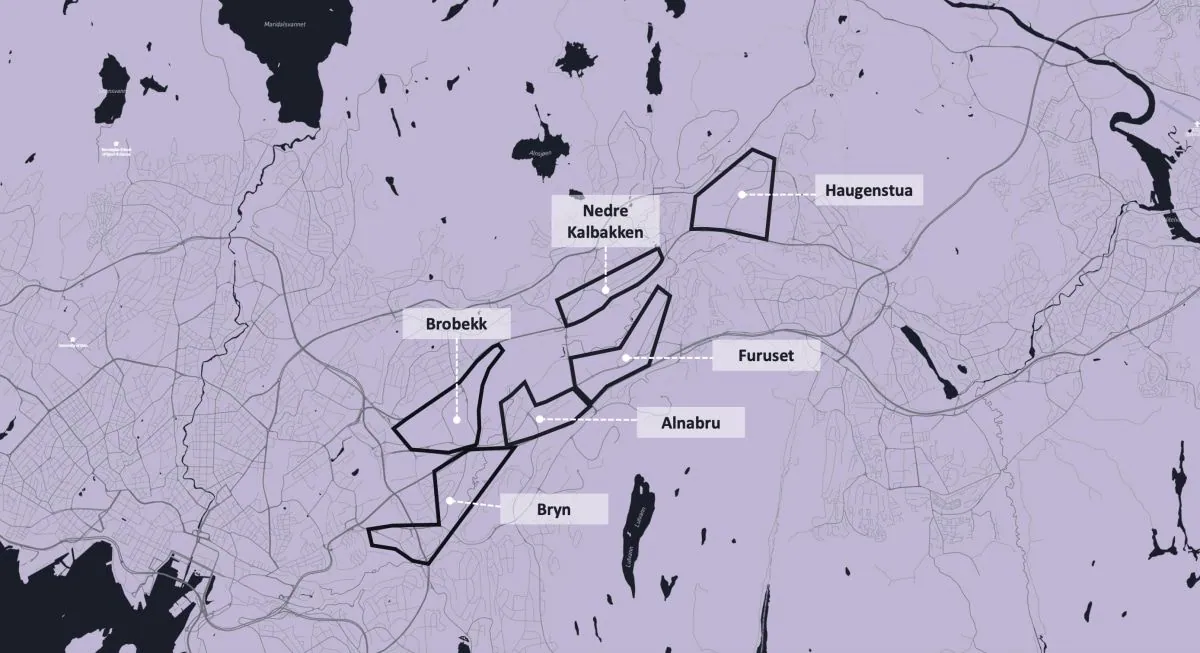
As described above, the warehousing and logistics market in Groruddalen is complex, and we often find that this is insufficiently communicated. Nor is it directly comparable with other large logistics areas such as Berger, Kløfta, Langhus, Vestby, etc. For that reason, we have zoomed in on Groruddalen and taken a deeper dive into six different sub-areas: Alnabru, Brobekk, Bryn, Haugenstua, Nedre Kalbakken and Furuset – see the map below.
We have used Create Solutions to delineate the areas and gather property-specific information for each area. The sample consists of warehouse, industrial and mixed-use buildings and covers the entire size of each building. Where there are several buildings on one plot, each building is counted separately, while the plot is included in the sample only once. Rents are based on signed leases in the area in question obtained from Arealstatistikk, as well as market-specific information held by Realnor. Below, the six sub-areas are presented with a description and an overview of the building stock and market conditions. The sample consists of 314 buildings with a total building volume of 1.6 million sq m. Total site area is estimated at approximately 3.4 million sq m.
Alnabru
Oslo's main freight terminal is located at Alnabru, and consequently large transport companies such as Posten, Postnord and Schenker have established large terminals in the area. These are not included in the description below.
Apart from the terminal buildings, Alnabru is the smallest sub-area for warehousing and logistics property measured by volume. It comprises a total of 65,000 sq m spread across 29 different buildings, with most of the building stock located north and north-east of ALNA senter. The building stock is relatively old and consists of small buildings of highly variable quality. It is therefore considered one of the least attractive areas in Groruddalen. That said, vacancy is low and the area can offer a good deal of outdoor storage, which is in high demand among certain players.
Brobekk
Brobekk stands out as one of the most attractive areas for warehousing and logistics buildings in Groruddalen. It comprises a total of 417,000 sq m spread across 62 buildings. Compared with Alnabru, the average building size is considerably larger, and the area is a more "typical" logistics area. The quality of the buildings is relatively good, but with some buildings of low standard. At the same time, there are also some new buildings at Brobekk, where Aspelin Ramm's new BREEAM-NOR Excellent building at Alf Bjerckes vei 22 is one of Norway's most modern logistics buildings. The same player is to refurbish and extend H&M's former main warehouse at Alf Bjerkes vei 26 and develop it into a logistics centre for two new occupiers. Brobekk also has relatively good parking provision and capacity for outdoor storage.
Bryn
Like Alnabru, Bryn has a good number of smaller warehousing and logistics buildings compared with, for example, Brobekk and Nedre Kalbakken. It comprises approximately 172,000 sq m spread across 60 different buildings, and much of the building stock is old. At the same time, the area contains a relatively large amount of mixed-use premises, factory buildings, workshops and, typically, smaller storage areas connected to offices, for example. The average site size is also considerably smaller than in all the other areas, and as a consequence few properties can offer outdoor storage at Bryn.
Haugenstua
Along Østre Aker vei at Haugenstua there are approx. 190,000 sq m of warehousing and logistics space spread across 55 different buildings. Access along Østre Aker vei is considered somewhat more demanding for heavy goods traffic and is less attractive than the areas along the E6. Most of the buildings are on the western side of the road and are relatively large. The sites are also relatively large, with an average site size of over 15,000 sq m, the highest of all six areas. This makes several of the properties suitable for outdoor storage.
Nedre Kalbakken
At Nedre Kalbakken, along Stanseveien and Stålfjæra, there are many medium-sized and some very large logistics buildings of varying standard. Large players such as Bama, Tine, Asko and Mantena have warehouse and industrial premises of between 30,000 and 100,000 sq m along Østre Aker vei by Stanseveien. All these buildings are in the south of the area, while the somewhat smaller buildings are further north. The smaller buildings are typically 1,000–8,000 sq m and are located along Stålfjæra and Stanseveien. Here, many of the buildings are old (average completion year 1975) and of relatively low standard. Of the six sub-areas, Nedre Kalbakken has the largest building stock, with a total of approx. 546,000 sq m spread across 74 buildings.
Furuset
Furuset lies along Professor Birkelands vei, north-east of Alnabru and opposite the E6. The area comprises approx. 245,000 sq m of logistics space spread across 56 buildings. Although the building stock is old, the area has many highly functional logistics buildings a short distance from the E6. The buildings are on average relatively small, and there is generally little capacity for outdoor storage.
Rents in Groruddalen
Rents in Groruddalen vary widely and are influenced by many factors. There are large differences between the buildings in Groruddalen as a whole, but also within the six sub-areas. Despite this, the differences in rents are relatively small, which suggests that all the areas have a wide variety of buildings. Based on figures obtained from Arealstatistikk and market-specific information held by Realnor, we have set out ranges for three different rent levels for Groruddalen:
- Low rent: NOK 700–1,000 per sq m
- Medium rent: NOK 1,000–1,400 per sq m
- High rent: NOK 1,400–1,750 per sq m
There is also a top segment where we have seen higher rents, with some leases signed at over NOK 2,000 per sq m. However, this applies only to a handful of buildings where all of the occupier's criteria are met.
Is an overly simplistic picture being painted of the warehouse market in Groruddalen?
All the areas we have reviewed above have different characteristics, qualities, challenges and peculiarities. Regardless of which area a specific property is located in, all the areas undoubtedly have qualities and features that players are looking for. The high demand has resulted in low vacancy in all the areas. As a consequence, the general rent level has received a significant boost after having been flat for a long time. It is nevertheless difficult to compare the areas with one another and to state rents for Groruddalen as a whole, or for each individual sub-area. When players ask us about rent levels in Groruddalen, we almost always have to give the boring answer: "it depends". We find that there is a very strong willingness to pay for a modern and well-suited logistics building in Groruddalen, regardless of where it is located. Likewise, there will continue to be a poor willingness to pay for an old and unsuitable building.
Occupiers focus on the total annual rent burden plus service charges. In other words, players think very little about whether they pay NOK 1,200, 1,400 or 1,800 per sq m, as long as the total rent is the same and their specific needs are met in the building in question. Put differently, they will be indifferent as to whether they pay NOK 2 m in annual rent, equivalent to NOK 1,700 per sq m, or NOK 2 m, equivalent to NOK 2,400 per sq m. For that reason, comparing rent per sq m can in many cases be like comparing apples and pears. They have certain similarities, but the differences can also be large. This applies particularly in Groruddalen, as many of the warehouse buildings have too large an office share relative to what players are looking for. Landlords often solve this problem by "throwing in" the extra office space at an exceptionally low price, or by trying to let it separately to another player. The latter has proved to be very difficult. Too high a proportion of offices relative to warehouse space is a recurring issue and a typical challenge for older buildings in Groruddalen.
The same problem arises if outdoor storage is built into the rent. Some players have a great need for outdoor storage and therefore have a higher willingness to pay for a property with satisfactory outdoor storage options. This can lead to further distortions when looking at averages, as it is not necessarily the building itself that accounts for the entire rent. Rather, it is the site and the property as a whole that determine what a player is willing to pay.
In addition, the building's features and qualities have a major impact. As mentioned at the outset, this greatly affects the occupier's willingness to pay and how lettable a building is. Factors such as standard, ceiling height, access, number of loading doors, chilled and/or frozen storage, location, age, facilities and size all affect the rent in one direction or the other. A good example of this is illustrated by Strømsveien and Caspar Storms vei at Bryn. Both roads have practically their own exit from the E6 and lie right next to the motorway. For some players, such access can be absolutely decisive, which pushes the rent up. Conversely, a property with awkward access may be considered unattractive and achieve a significantly lower rent.
All the factors mentioned above help determine the rent for a given building, and for that reason each building must be assessed on its own merits if one is to give a good estimate of the rent level for a specific building. Despite the above, we at Realnor often find that rents for warehousing and logistics space in Groruddalen are communicated in a way that can give an overly simplistic, generalising and misleading picture of the market. There is very often a lot of noise in leases that is not taken into account when looking at averages, as described above. To put it bluntly, we find that there is to some extent a perception that most warehouse buildings in Groruddalen can be let at NOK 1,500 per sq m. Given that rents for the very best buildings have risen sharply, many may be tempted to think that the rent for "average" buildings lies midway between prime and bottom rents. In our experience and view, this is wrong. There are large differences, and many buildings are still let at NOK 700–1,000 per sq m. At the same time, only a handful of buildings can be let at over NOK 2,000 per sq m.
Going forward, we believe the gap between the extremes will widen, creating an even clearer divide between the best and the less good buildings in Groruddalen. It is typically the largest players with the greatest ability to pay that place the highest demands on a property's qualities. The same players are often at the forefront when it comes to sustainability and environmental performance in buildings, which results in higher rents. At the other end, there are still a large number of small and medium-sized businesses that are often more price-sensitive and place fewer demands on a property's qualities. There will therefore always be a market for the supposedly poorer buildings, but whether these players are willing to pay sharply increased rents is uncertain.
