Charts are reproduced from the original Norwegian report.
A weak krone deepens Norges Bank's dilemmas
A mixed picture currently characterises both the Norwegian and the international economy. Internationally, the outlook for some countries has improved since last quarter, while for others it has moved in the opposite direction. Germany, Europe's largest economy, is in recession, and retail sales have fallen continuously since March 2022. Statistics Norway (SSB) stresses that the general downside risk is substantial and that the economic situation is challenging for many countries. While central banks are to stabilise inflation, they must also safeguard financial stability, which historically has proved to be a demanding task.
In Norway, the economy is marked by a weak krone, which has given Norges Bank further headaches. Both the euro and the dollar peaked on 31 May this year, at 12 and 11.2 kroner respectively. The Norwegian krone has strengthened since then, but is still significantly down this year. As a result, it takes longer for the central bank to reach the inflation target. The krone exchange rate is projected to remain unchanged going forward, and consequently a higher policy rate is expected and any cuts in the policy rate are pushed further out. Despite sharp rate rises, high inflation and a weak krone, the state of the Norwegian economy is relatively stable.
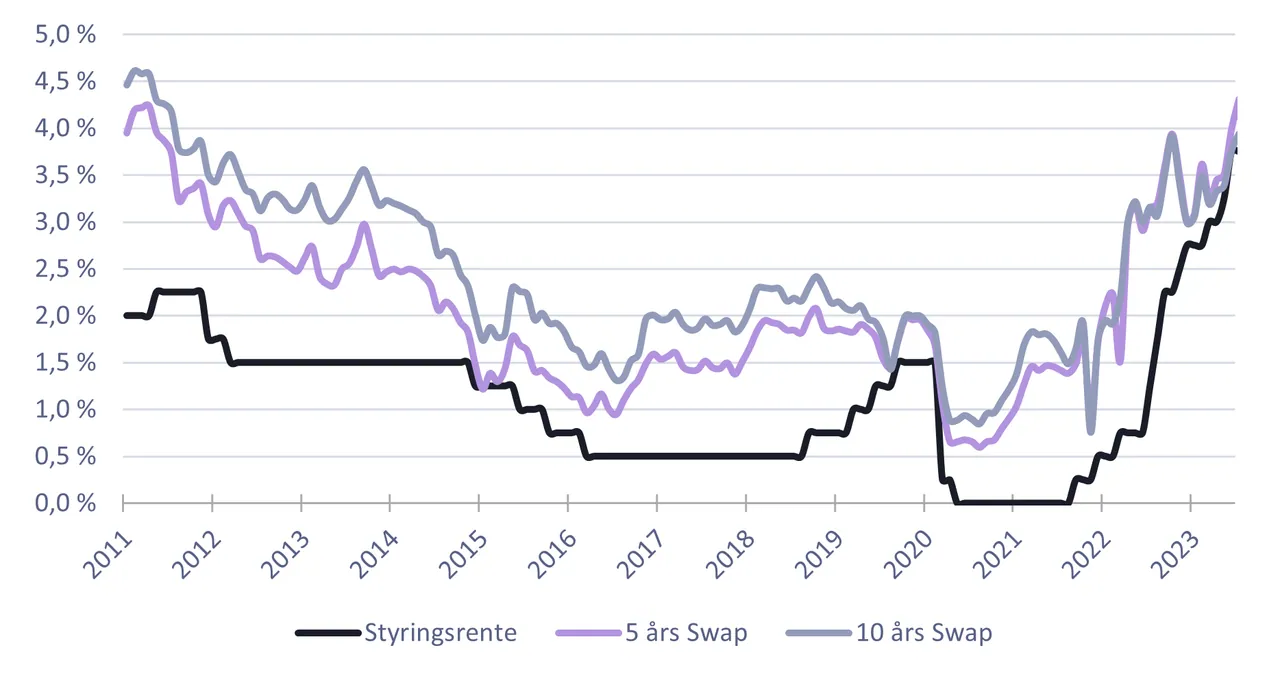
Growth in the Norwegian economy has, however, slowed, and mainland GDP fell 0.4 per cent from March to April. In May growth picked up somewhat again, rising 0.5 per cent from April. Monthly figures are volatile, and the rolling three-month growth rate may therefore give a better indication of the underlying economic development. Over the most recent three-month periods, GDP growth has been close to zero, and there are signs that inflation and higher interest rates are beginning to affect household purchasing power.
Consumption by households and non-profit organisations fell 1.8 per cent in April, and consumption of goods declined by 3.3 per cent in the same period. This is an unusually large fall. According to SSB, consumption of goods has been on a downward trend since December last year. It nevertheless expects growth in the years ahead to be close to trend level. Mainland economic growth of 1.3 per cent is expected in 2023. This is underpinned by a strong labour market and expected high wage growth in 2023. Nevertheless, high inflation will lead to a decline in real wages in 2023, according to SSB's estimates.
Tight labour market, but a decline in real wages this year too
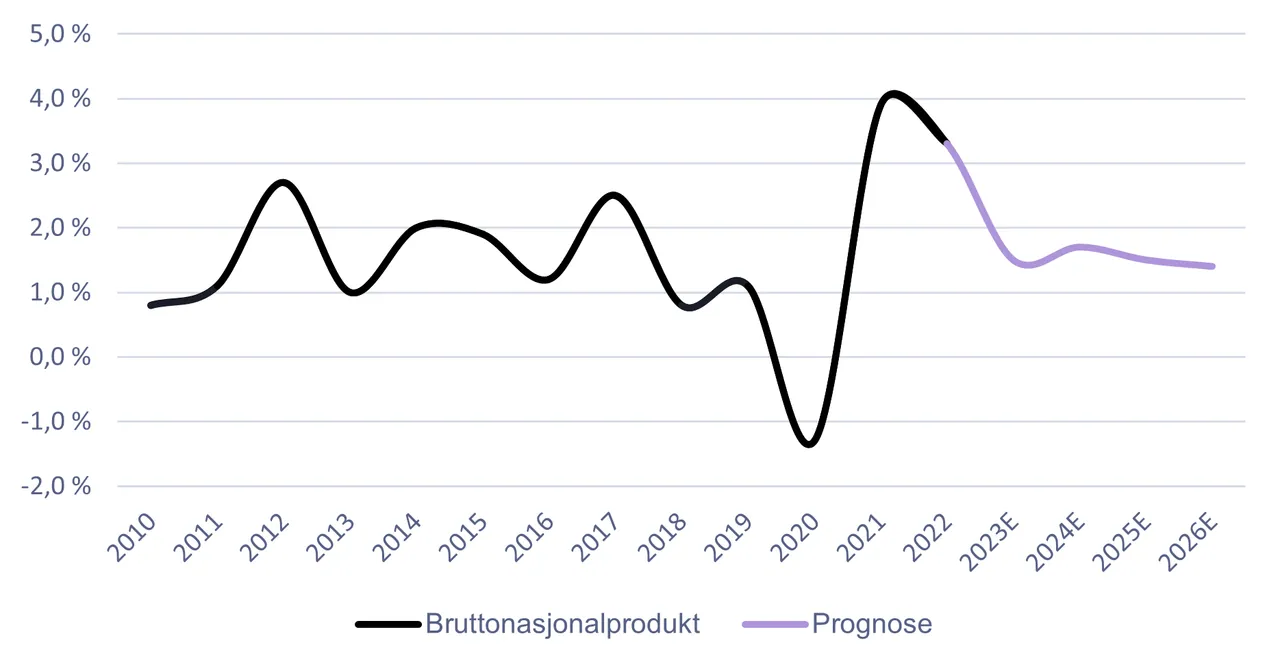
The Norwegian labour market is still holding up well, and unemployment has been around 3.5 per cent (Labour Force Survey) in recent months. This is slightly higher than at the same time last year, but the changes from the first quarter are small. The industries that have seen the largest increase in unemployment are retail trade and construction, with increases of 4,800 and 2,800 unemployed respectively from last quarter. Unemployment in these industries accounted for approx. 22 per cent of total unemployment and is now at a historically high level.
While unemployment is low, the number of vacancies is high, which may indicate a shortage of qualified labour. In such a situation, employers will in many cases have to raise wages to recruit new qualified employees, which in turn may contribute to higher wage growth overall.
According to SSB, there have been some indications that pressure in the labour market is easing. It expects this development to continue as a result of weaker international growth prospects, higher interest rates and lower demand in many industries. Unemployment is projected to rise steadily towards 2025, ending at about 4.0 per cent. SSB's forecast for annual wage growth in 2023 has been revised up from 5.0 to 5.3 per cent. Despite a higher estimate for annual wage growth, this implies a decline in real wages this year too, as a result of a higher CPI forecast. Going forward, SSB expects annual real wage growth of about 2 per cent from 2024 towards 2026.
Is there light at the end of the interest-rate tunnel?
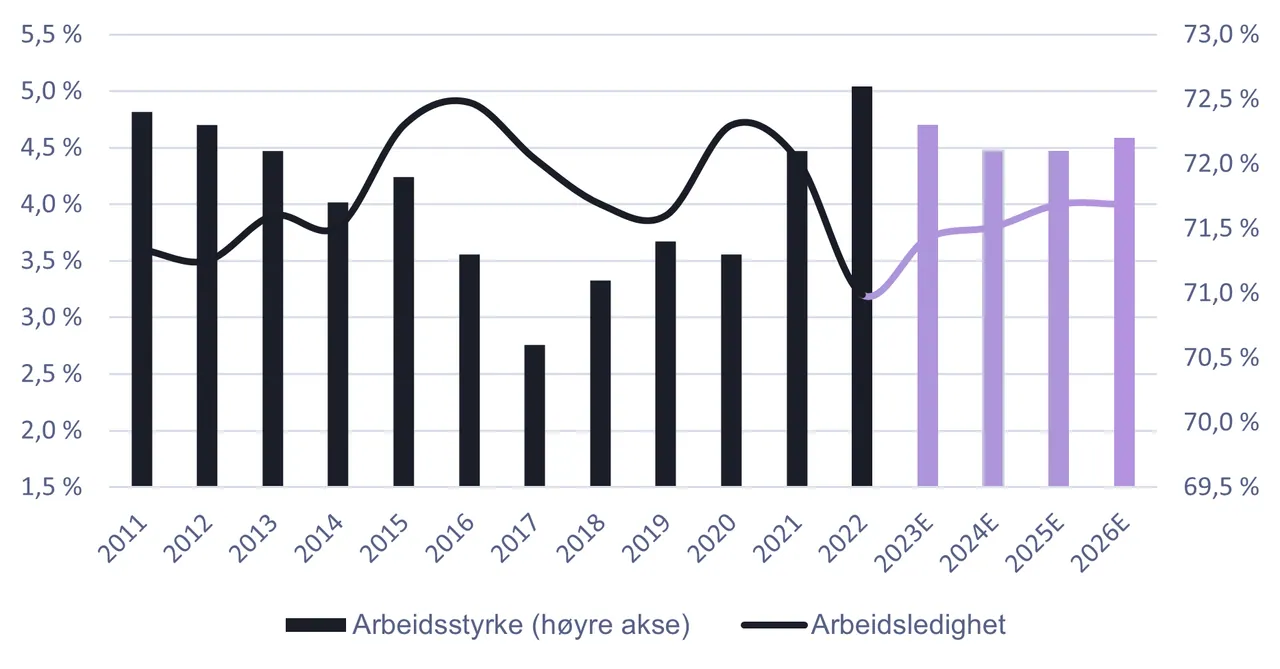
Inflation remains high and consequently puts pressure on Norges Bank in its rate-setting going forward. The policy rate was raised by 25 basis points in May, 50 basis points in June and a further 25 basis points in August. Since September 2021 it has gone from 0 to the current 4.00 per cent. One more rise by Norges Bank is expected during the autumn. The policy rate has risen sharply in a short space of time and, as in the previous quarter, Norges Bank faces demanding monetary policy trade-offs.
Activity in the Norwegian economy is relatively high, even though mainland GDP growth has slowed so far this year. There is also a moderate rise in unemployment, but from a low level. Further rate rises will slow economic activity further, but SSB expects Norges Bank to prioritise curbing inflation and strengthening the krone in its rate-setting going forward. Persistently high inflation combined with a weak krone exchange rate is likely to have a greater negative impact on the Norwegian economy and will therefore weigh most heavily in rate-setting going forward. For that reason, a clear weakening of both the economy and inflation will probably be needed before the policy rate is held unchanged.
The money market rate is above 4 per cent (as of June) for the first time since 2008, and SSB expects it to remain around this level in the time ahead. Mortgage rates will consequently approach 6 per cent during 2023 if the policy rate is raised as expected. Over the next year, SSB expects inflation to come down to 3 per cent in 2024, and the policy rate will not be cut until the second half of 2024. Rate cuts will then continue in 2025 and 2026, and the money market rate is expected to fall below 2.5 per cent during 2026.
A sharp rise in food prices lifts inflation
Inflation, measured by the CPI, rose 6.7 per cent year on year in May and continues to surprise both SSB and Norges Bank on the upside. In June inflation fell back somewhat, to 6.4 per cent, but it has undoubtedly stabilised at too high a level. According to SSB, price growth is driven in particular by the prices of food, rents and air travel. Food contributed most to the rise in the CPI, with price growth of 2.4 per cent from April to May and 2.5 per cent from May to June. Over the past three months there has been exceptionally strong growth in food prices, and the change from June last year to June this year was a full 13.7 per cent. This is the highest twelve-month change recorded for food since the 1980s. The sharp price increase is partly a result of Kiwi not raising prices on 1 February, but rather spreading the price increases out over time through the spring. At the same time, a weak krone is pushing up import prices and lifting inflation expectations going forward. Rising food prices are also evident abroad, and together with a weak krone exchange rate this results in a strong increase in the prices of imported food. Food has a weighting of almost 13 per cent in the CPI calculation and contributed approximately 1.6 per cent of total price growth from June last year to June this year. Food was also the largest contributor to inflation in the second quarter.
Furthermore, rents have risen sharply over the past year and are 4.2 per cent higher than a year ago. Rents also carry a significant weight in the CPI calculation and thus contribute strongly to pushing inflation up. As residential leases are usually adjusted for inflation at the turn of the year, high price growth will over time be reflected in higher rents, according to SSB. On this basis, as well as high demand for rental housing, SSB expects rents to continue rising this year.
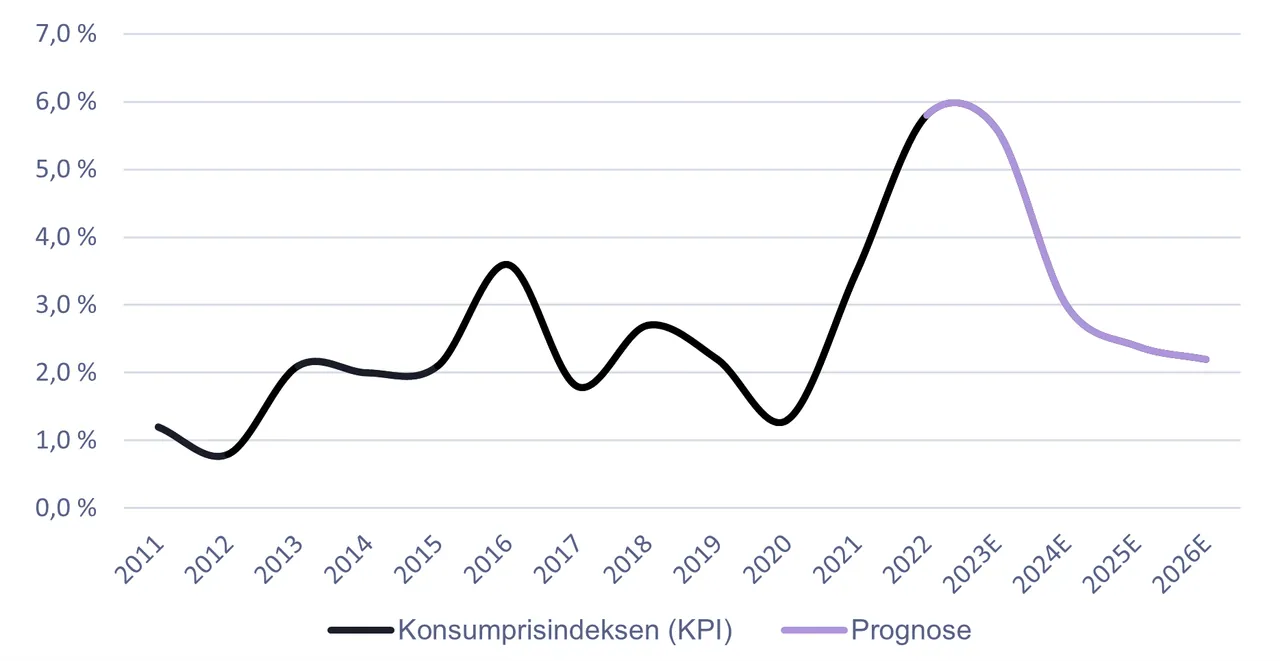
Since its previous economic report (March 2023), SSB has revised up its annual forecast from 5.0 to 5.6% inflation in 2023. Last quarter there was relatively broad consensus that inflation had peaked, but it is apparently remaining higher and for longer than expected. Although inflation continues to surprise on the upside, as it has done for seven consecutive quarters, SSB emphasises that inflation is on its way down. Developments in energy prices in particular are helping to pull inflation down. A weaker krone means it will take somewhat longer to come down towards the inflation target, while a higher policy rate will help dampen price pressures and potentially strengthen the krone.
CPI-ATE ended at a record-high 7.0 per cent in June and is expected to be somewhat higher than the CPI going forward. The reason is mainly lower electricity and fuel prices, and underlying price growth is expected to end at 6.0 per cent this year. According to SSB, it takes time before higher labour costs and international price impulses measured in Norwegian kroner are passed through into higher consumer prices. After a period of high underlying price growth, rapidly falling international price growth will gradually pull down inflation in Norway. In 2024, CPI-ATE is expected to fall to around 3 per cent. CPI growth is not expected to come down towards the 2 per cent inflation target until 2025.
The property market
What will it take to lift the transaction market?
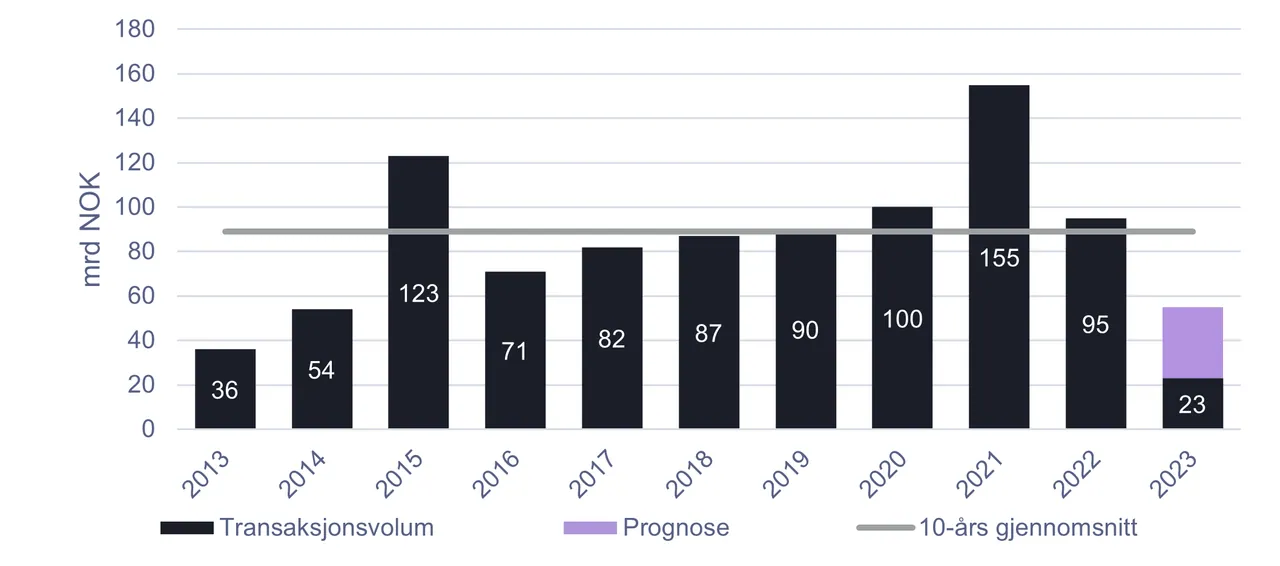
Transaction volume in the second quarter was just over NOK 10 bn, somewhat lower than in Q1. Total transaction volume for the first half of 2023 amounted to just under NOK 23 bn across 84 transactions. The trend from last year and the first quarter of this year has continued into the second quarter, and activity in the transaction market remains very low. Compared with the average for the first six months of the past four years, transaction volume is down approx. 42%. Based on this development, we have reduced our forecast for total transaction volume in 2023 to NOK 55 bn.
The negative development in the transaction market is still linked to the sharp increase in, and volatility of, interest rates. In the second quarter, as mentioned, the money market rate rose above 4 per cent for the first time in 15 years. Long-term rates have also risen, and the five-year swap rate stood at 3.97% as of mid-June. This means that financing costs for property players have increased considerably in a relatively short time, while banks have also become more cautious about providing capital. According to UNION's bank survey, the bank margin on a five-year loan with a 65% loan-to-value ratio has risen by 15 basis points so far this year. Today's bank margin and five-year swap rate correspond to a financing rate for new loans of approximately 6.5%. In 2020 and 2021, the equivalent financing rate was between 3.0 and 3.75%, and this development has sharply slowed the transaction market.
Higher financing costs for property players have pushed yields up from record-low levels. Yields are still under upward pressure, and there is currently too wide a gap between buyers and sellers. Although some transactions are being completed, the general perception is that the market is not in equilibrium. To get the transaction market moving, in many cases it will be necessary for players to be forced to sell property due to financial challenges. We have seen such a situation at Entra, for example, which sold two properties in central Oslo for approx. NOK 1.5 bn in May. For such central properties in Oslo and "trophy properties", we still see good interest and willingness to pay.
Going forward, interest rates are expected to rise further and to remain at a higher level for longer than expected. The transaction market will consequently be affected, and it will probably take longer before activity picks up again. We find that the situation in the transaction market has not changed significantly in the second quarter, and many property players still have a "sit tight" mentality. Most players see no reason to rush and take unnecessary risks. The expectation is that property prices will sooner or later come down, and only then will they increase their level of activity.
In the first half of 2023, the highest volume was transacted within the residential segment, with a share of 27%. For residential sites and development projects, activity is high and the market is holding up relatively well. For example, a UNION fund recently acquired Bonava Norge for NOK 1.5 bn, the second-largest property transaction of the year. The portfolio consists of approx. 350 apartments under construction and a land bank of 3,600 homes. Furthermore, offices have accounted for a share of 24%, development property 20%, while warehouse/logistics property and mixed-use property have accounted for 14% and 5% of transaction volume respectively.
The office market – occupiers gravitate towards the city centre
The office market is the largest property segment in Norway in terms of total floor area and transaction volume. Within Norway's four largest cities there are approx. 17.4 million sq m spread across more than 4,100 buildings. The office market is also the market with the highest prime rents and the lowest prime yield levels in the country. As in the previous quarter, there is considerable uncertainty about what prime yield is in today's market. No transactions give sufficiently good indications of the level, and to some extent one has to reason and speculate to arrive at an estimate. Transactions with yields of around 4 per cent have been reported, for example Tvenge's acquisition of Henrik Ibsens gate 53 and Inkognitogata 34 at Solli Plass in Oslo. If one applies the definition of prime yield – prime location, market rent, new-build standard, strong occupier and a 5–10-year lease – and adjusts for these factors, the transaction mentioned would have a yield of between 4.6 and 5.0 per cent. The difference between the yield at which the property was acquired and the "adjusted" yield is mainly because today's market rent is higher than the existing rent for the building in question. For that reason, the transaction yield does not constitute "proof" of what prime yield actually is. Generally speaking, many of the transactions being completed in today's market also include a value-add element.
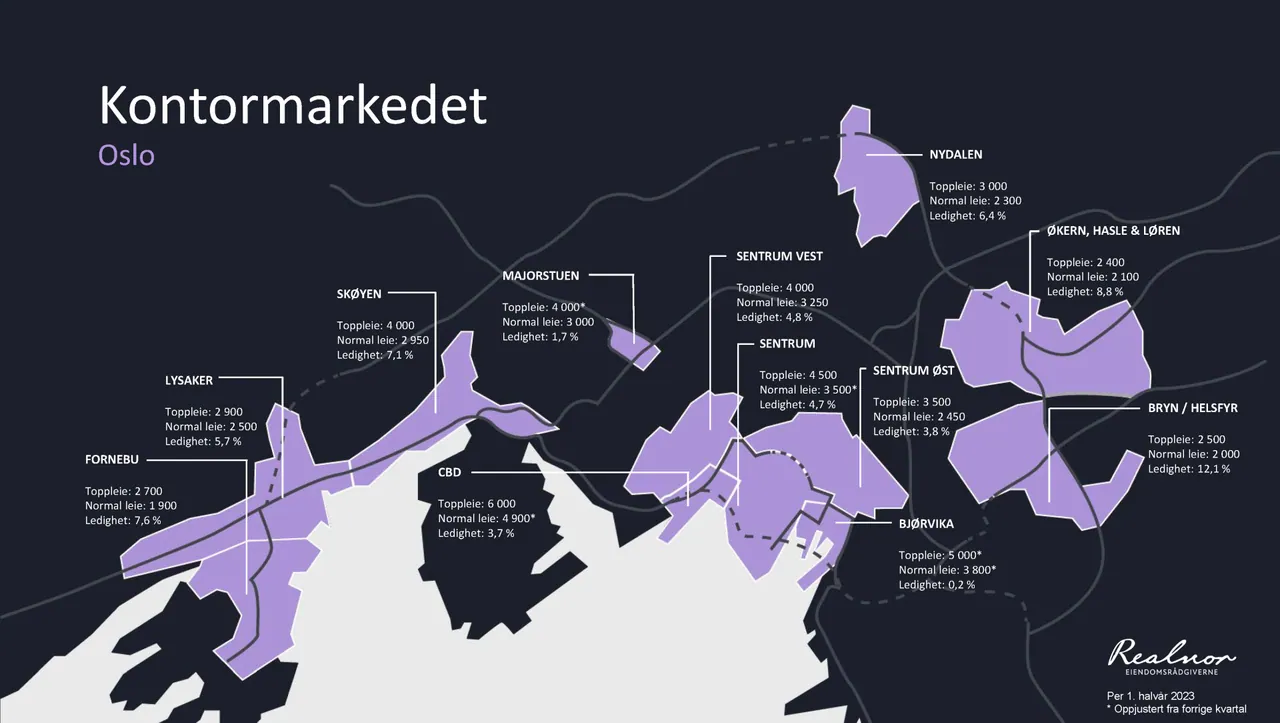
Office vacancy in Oslo stood at 5.6% as of June 2023, a decrease of 1.0% from June 2022. Vacancy in Oslo continues to remain low, fluctuating between 5.6 and 5.8 per cent. Leasing volumes in the second quarter were relatively good measured in square metres signed, and activity in the letting market has been fairly normal. Although unemployment has risen somewhat and forecasts point to further increases, office vacancy in Oslo is expected to remain relatively low in the time ahead as well. In the second quarter there are also no clear signals that reduced economic activity has significantly dampened activity in the letting market. We nevertheless expect rental growth generally to slow in step with the slowdown in the economy, but the Oslo office market to remain strong as a result of an imbalance between supply and demand.
The expected low office vacancy in 2023 and 2024 is strongly driven by moderate new-build activity and thus a limited supply side. In both 2023 and 2024, new-build activity will be far below the average of the past 20 years. The same was the case in 2022, resulting in low vacancy and pressure on rents. In addition, a high volume of leases is expiring over the next few years, implying high activity in the letting market.
In 2023 there has been an increase in the proportion of occupiers seeking offices in central Oslo. We find that many companies value and prioritise premises located close to public transport hubs and with a wide range of amenities near the workplace. In order to attract, recruit and retain the best employees, and to create an attractive workplace for both current and future employees, they strive to accommodate employees' preferences regarding location. This trend has been one of the reasons for the significant increase in rents in central parts of Oslo, and we expect this increased demand to continue in the future.
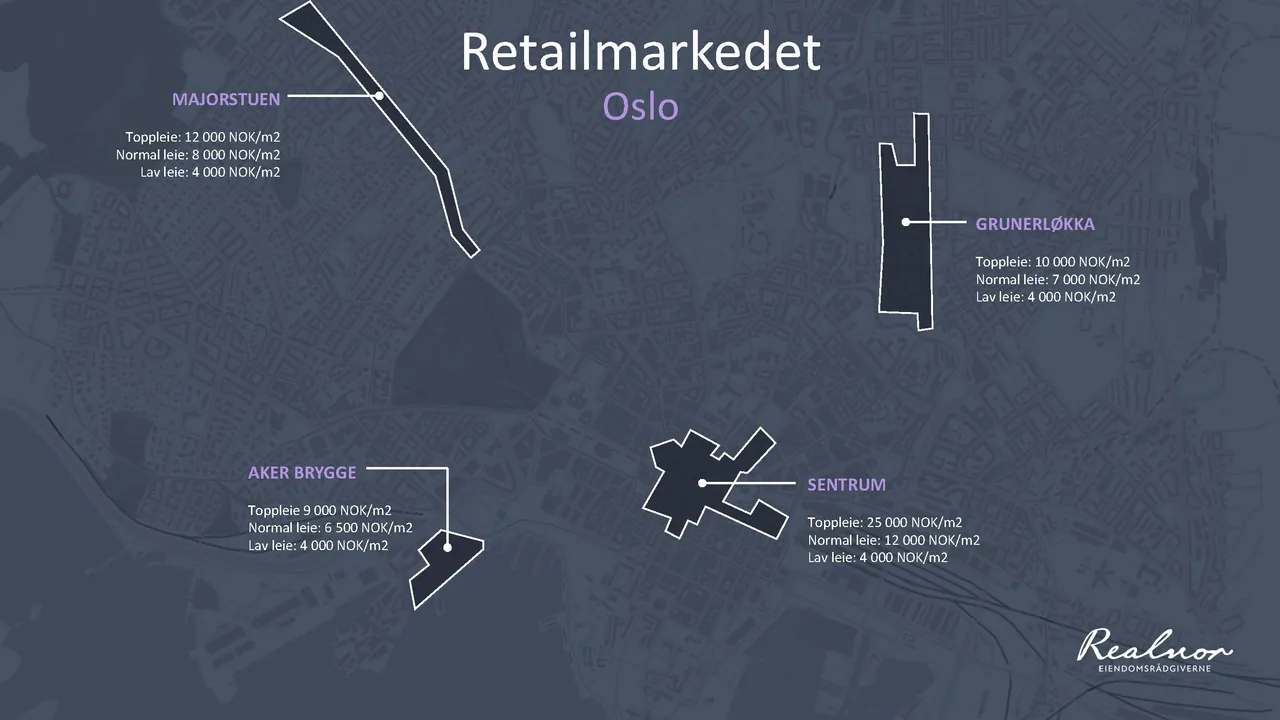
This development is also reflected in rental growth. Rents in the CBD and the inner city centre continue to move higher – both on average and in the top segment. The best premises in the most central areas have stabilised and continue upwards, while most other areas remain relatively stable. The Vika–Aker Brygge area has seen growth in average rents over the past five quarters, and so far there are no factors indicating that the top segment is being significantly affected by macroeconomic headwinds.
Above NOK 2,000 per sq m in the logistics market for the first time
As of June 2023, a transaction volume of logistics and industrial property of just over NOK 3 bn has been recorded, accounting for approx. 14% of total transaction volume. There has been very little activity in the logistics market this year, especially compared with 2021 and 2022. Volume is low and few transactions are being completed. Almost 90 per cent of total volume comes from two large transactions, most recently Fabritius's sale of two new and modern logistics properties in Moss for approx. NOK 1.5 bn. The buyer was the equity-financed French fund Axa IM Alts, following a bidding round with strong competition from both Norwegian and international players. The transaction shows that it is possible to complete transactions, albeit at lower levels than in 2021 and 2022. As in the rest of the property market, buyers are more hesitant and processes take longer. The market for warehousing and logistics property nevertheless appears relatively good, particularly for high-quality properties with strong occupiers. This still requires that sellers do not expect "yesterday's" prices and that they are willing to accept today's market conditions.
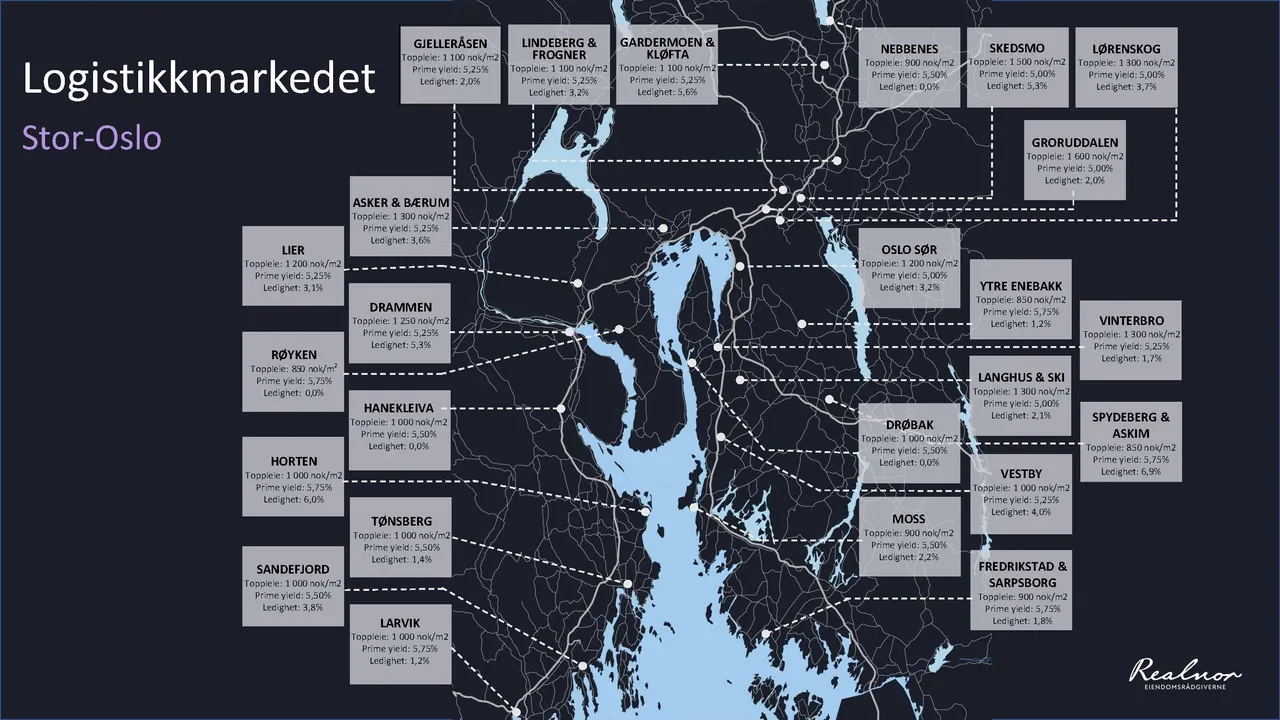
Yields have also risen in the logistics market, but as in the office market, the decline in values is limited by a strong and rising letting market. In the first half of the year, average rents in Greater Oslo rose by a full 10 per cent compared with 2022, according to Arealstatistikk. Rents for category A (the 15% most expensive leases) have risen by 11 per cent and are above NOK 2,000 per sq m for the first time. For category D (bottom 10%), the development is virtually flat, in line with previous forecasts – the gap between the best and the worst properties is widening. Half-year figures naturally contain fewer leases and lower volumes than full-year figures, which must be taken into account. Nevertheless, the trend is positive and the letting market remains strong.
A good tenant mix will be decisive for retail players
Although the year started surprisingly well for both shopping centres and retail overall, in the second quarter there are signs that households are beginning to feel higher prices and interest rates. According to Kvarud Analyse, turnover over the past three months also suggests that the period of very high growth rates for food and beverage outlets and service businesses in shopping centres is over. Although growth rates are somewhat down over the past three months, turnover at the end of May was nevertheless 10.4 per cent above what these businesses turned over in the first five months of last year. For both food and beverage outlets and service businesses, turnover so far this year has risen by 10.5 per cent, while growth in "other businesses" (mainly healthcare services) has been 15.2 per cent.
Retail sales volume in the second quarter is up 0.3 per cent compared with the previous three-month period, according to seasonally adjusted figures from SSB. Most sectors have seen very moderate development, with the main contribution coming from grocery retailing. Grocery prices have risen considerably, while volumes are also increasing, indicating that households are prioritising this category. At the other end, households usually reduce purchases of durable goods in downturns, which is also evident in today's market.
There are signs that the downward trend is levelling off somewhat, but SSB and Kvarud point out that higher costs for households will have a negative impact on consumption of goods in the time ahead. Many players in the retail market will feel the negative development in consumption of goods keenly. When the effect of the recent rate rises kicks in, households will feel it even more strongly, and as households become more price-conscious and selective, this is likely to feed directly into the retail market. At such times, it will be particularly important for property players in the retail segment to have a good tenant mix in their portfolio.